Oils and lubricants are used in various industries in the modern age, most commonly for operation of motor vehicles and in the culinary arts. There are also other types of lubricants, such as biomedical lubricants that can reduce friction in artificial joints as well as gels used in ultrasound examinations. There is always a market for oils and lubricants, and Ebatco can test consumer products so that it meets the needs of any customer base.

At Ebatco, material testing is handled by our skilled team of laboratory scientists. Our laboratory scientists use the utmost care when handling customer samples, conducting material testing efficiently and accurately, and prepare professional reports that give results both numerically and graphically. The services and data that Ebatco provides will integrate well into company development or verification plans. Whether desired testing includes the surface tension of aqueous samples or the numerical reduction in friction after lubrication, Ebatco has it covered.

At Ebatco, there are a multitude of mechanical testing instruments that can be used to test or verify the properties of oils and lubricants. Our team of skilled laboratory workers can test aqueous surface tensions, zeta potential as a function of liquid pH, nanotribology, and the lifespan of a material when introduced to an oil or lubricant. If you have any questions about the services or instrumentation available at Ebatco, feel free to call or email and a member of our team will be able to further assist you.

Applications

Analysis of materials for surface functionalitiesAnalysis of petroleumIdentification of chemical impuritiesInvestigation of friction under lubricationNanotribology
Lubrication of solidsTribochemistry and tribophysicsWear under boundary lubricationWear mechanism study 
Viscosity of Motor Oil as a Function of Temperature

Viscosity is a useful fluid parameter used to describe a fluid’s internal friction or resistance to motion. A large viscosity will require a large shear force to overcome the internal friction. Shear forces can occur during operations such as pouring, mixing, spreading, or spraying.

The internal friction arises from attractive forces between the molecules of the fluid. When a shear force is applied, it must overcome the intermolecular forces in order to move the liquid.

Parallel plate viscosity testing of fluids

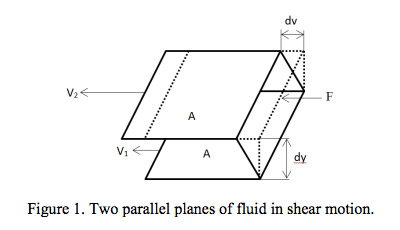
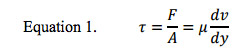
Newton defined viscosity, μ, by considering a situation like Figure 1 where two parallel planes of fluid of equal area, A, are separated by a distance, dx, and traveling at different velocities, V1 and V2. He assumed that the shear stress, τ, required to cause the difference in velocity was proportional to the change in velocity across dx, or the velocity gradient. Mathematically, it is expressed as Equation 1.

Shear stress from newton defined viscosity equation

Fluids that behave according to Equation 1 are called Newtonian. Typical Newtonian fluids are water and thin lubricating oils.

Motor oil viscosity is an important consideration for improving the performance and extending the lifetime of any engine. If the oil viscosity is too low, the lubrication layer between parts will be too thin to prevent engine parts from grinding against each other. However, if oil viscosity is too high, the oil may not pump properly during start-up when the engine is still cold. This requires that the correct viscosity oil be used.

To facilitate this, oils are classified based on their viscosity and given a certification grade, such as 5, 10, 20, 30 40, or 50; these grades are defined by the Society of Automotive Engineers (SAE). Some oils are given two ratings, such as 5W-30, to indicate oil that has been treated with additives to flow like SAE 5 oil at start-up but SAE 30 after the engine reaches operating temperature. This allows for better engine performance and lifetime.

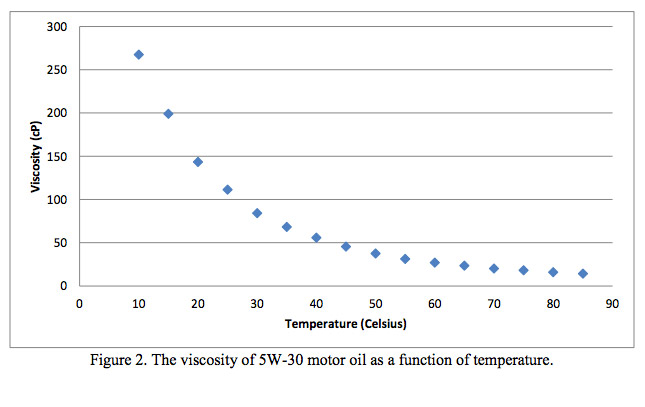
A 5W-30 motor oil was tested using a Brookfield LV-II+ Pro Viscometer. This viscometer has a measuring range of 1 cP to 6•(10)6 cP (1 cP is equal to 10-3 Pa•s). Coupled with appropriate temperature control equipment, the LV-II+ provides excellent accuracy and repeatability in viscosity measurements at temperatures ranging from -20oC to 300oC. The measurement results are presented in Figure 2.

Viscosity of motor oil as a function of temperature