Ebatco offers a variety of micro- and nano- mechanical testing instruments that our team of scientists expertly operate to complete projects for research and development teams. High quality material testing can be a crucial part of turning ideas into reality by ensuring that each material aspect of the product will both function correctly and offer longevity. Research and development is an important and challenging part of designing a new product and Ebatco wants to make sure that the ideal product can be taken to market.

Material testing is critical to ensure that your newly developed product has all of the desired characteristics to guarantee it operates as desired. Whether the new product is intended for specialized use or the general public, it must be able to properly operate in the desired conditions. With a professional testing report from Ebatco, gain confidence that the developing product has the desired material characteristics.

Our mechanical testing instrumentation can be used to calculate a wide range of mechanical properties including: zeta potential, contact angle, surface free energy, and many other properties that will allow for a greater understanding of behavior. If you have any questions about the services or instrumentation available at Ebatco, feel free to call or email and a member of our team will be able to further assist you.

Applications

Characterizing transient and dynamic liquid-solid interactionsDetermination of solid surface zeta potentialDifferentiation between phase transformation and decompositionEvaluation of interphases, grain boundaries, and multiphasesHigh temperature contact angle
Investigation of film adhesion at high temperaturesMicroscopic wetting & microfluidicsSurface free energy analysis  
Friction of Contact Lenses in Saline Solution

Friction is a measure of a surface’s resistance to motion. When two surfaces are rubbing against each other, friction acts as the force to prevent the two surfaces from moving in a given direction. Continued relative motion leads to material loss or wear of the surface and its friction counterpart. Over time, a surface will degrade to a point that renders the surface unusable for its designed application. Altering the surface chemistry can change the friction properties to better suit the application needs and help to prolong the material’s useful life.

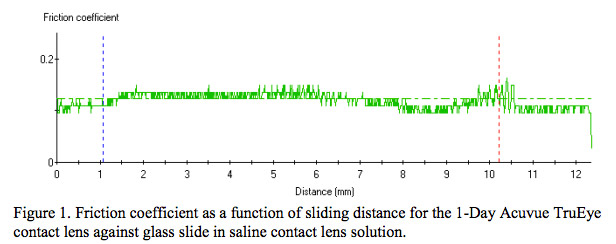
Friction coefficient vs distance plot against contact lens

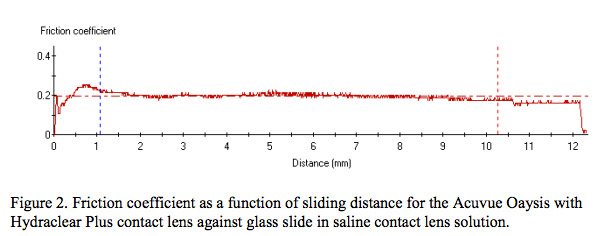
Friction coefficient vs distance plot against contact lens

The TS-501 Triboster, manufactured by Kyowa Interface Science Co., Ltd., is capable of measuring both the static and kinetic friction coefficients of a material surface in a single pass or multiple passes under dry or lubricated conditions with temperature control from room temperature to 180ºC. The high sensitivity friction transducer and low loads employed by the TS-501 allow for softer materials like polymers, fabrics and thin films to be tested with ease and accuracy. The velocity of the stage is automatically controlled by user input values from 0.02mm/s to 100mm/s.

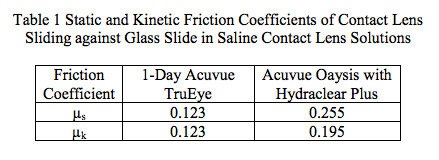
Static and Kinetic Friction Coefficient Tables

Most of the disposable contact lenses are made of extremely soft hydrogels with a significant amount of water content. Wearing contact lenses is becoming trendy for people whether it is for cosmetic, corrective or therapeutic reasons. In addition to many designed functionalities of the contact lenses wearing comfort is a key factor to be well controlled by the contact lens designer. One of the aspects of the wearer’s comfort is the friction between eyelid and the contact lens.

As shown in Figures 1 and 2, and Table 1, two different kinds of commercially available contact lenses from Johnson & Johnson Vision Care, Inc. were tested for friction using the TS-501. The first kind of contact lens tested was 1-Day Acuvue TruEye disposable contact lens. The second kind of contact lens was Acuvue Oaysis Hydraclear Plus disposable contact lens. Both kinds of contact lenses were tested under the same conditions and parameters sliding against glass slide in saline contact lens solution. From the results it is obvious that the static and kinetic friction coefficients for the two kinds of contact lenses are different. The different friction coefficients would result in different wearing comfort for people.