Semiconductors play a large role in the electronics industry – using the materials to run devices such as cell phones, medical devices, and computers. The most common semiconductor used in industry today is silicon, but it is far from being the only semiconductor used. Regardless of which material is chosen for a semiconductor, it is crucial to know the material properties in order to discern if it will function properly in all environments to which it could be exposed.

Ebatco offers a wide range of micro- and nano- scale mechanical testing instrumentation which our team of scientists can expertly operate in order to fulfill the needs of your laboratory services. Some of the tests include characterization of the surface coating, the mechanical properties pre- and post- wear of that coating, and nanoindentation of the thin films that are incorporated with semiconductors. Getting accurate results will allow you to know that your electronics will not fail due to having the wrong semiconductor.

It is critical that every semiconductor in an electronic device functions properly. The material data we provide at Ebatco can prevent a product from failing, which can help avoid the need to recall an item due to a malfunctioning semiconductor. If you have any questions about the services or instrumentation available at Ebatco, feel free to call or email and a member of our team will be able to further assist you.

Applications

Dimension change analysis from heatCharacterization of surface coatingCoating damage due to wear and scratchesElemental analysis of small componentsEstimation of surface charges
Evaluation of whiskering and electro-migrationInterfacial adhesion of film to underlayerNanoindentation of ultrathin films  
Time-Temperature Superposition Using Dynamic Mechanical Analysis

With their low cost and ease of manufacture, structural polymer components have become increasingly common in consumer products. While switching from metal to polymeric components can decrease the material cost of a product, there are additional design considerations to take into account. One of those considerations is the viscoelastic nature of polymeric materials.

The time and temperature dependent behavior of polymers is due to their molecular structures. As a polymer is stressed, it undergoes molecular rearrangement in an attempt to relieve the stress. This results in an apparent decrease in stiffness (or storage modulus) over time. This would seem to imply that polymers must be evaluated for specific applications by testing under the conditions they will be subjected during use. Fortunately, there is a demonstrated relationship between the time (frequency) and temperature at which a material is tested. In other words, it is possible to determine very low (or high) frequency properties by simply testing the material at a higher (or lower) temperature. This relation is known as ‘time-temperature superposition’ (TTS).

Dynamic mechanical analysis (DMA) characterizes the viscoelastic behavior of materials by applying a sinusoidal force to a specimen and measuring the material response. It is one of the most sensitive and accurate techniques for applying the time-temperature superposition principle.

Time-Temperature superposition of isotherms for dynamic mechanical analysis (DMA)

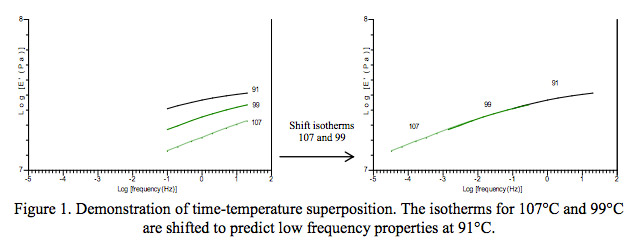
With TTS, it has been demonstrated that it is possible to determine material properties for very low or high frequencies by performing creep, stress relaxation, or multiple frequency tests at a variety of different temperatures. By shifting the isothermal data along the time (frequency) axis, it is possible to obtain a single isotherm, typically referred to as the ‘master curve,’ of the modulus for a much broader range of frequencies than was tested. This is illustrated in Figure 1. The amount of shifting required to obtain the master curve can be mathematically described by the Williams-Landel-Ferry equation, shown in Equation 1.

Williams-Landel-Ferry equation using temperature and shift factor

In this equation, T0 is the reference temperature, i.e. the temperature to which all the isotherms are shifted. T0 is typically defined as the glass transition temperature, Tg. C1o and C20 are empirical constants (17.4 and 51.6, respectively, for many amorphous polymers), T is the temperature of the isotherm to be shifted, and aT is the shift factor.

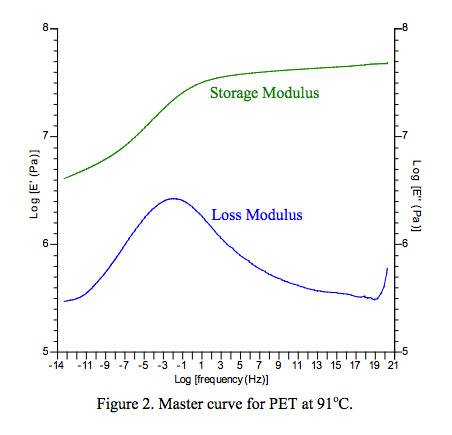
To illustrate the principle of TTS, Ebatco’s NAT Lab tested poly(ethylene terapthalate) (PET) ribbon at a variety of temperatures and frequencies. By applying the WLF model, the isotherms are shifted to create a master curve for the storage (E’) and loss (E”) moduli at 91°C, the glass transition temperature of the material, presented in Figure 2.

Storage modulus and loss modulus curves for PET