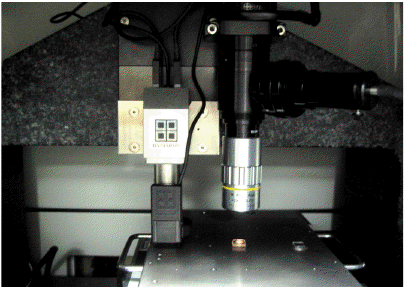
The nanoscale dynamic mechanical analysis (nanoDMA) technique is accomplished on a nanoindenter with a dynamic mechanical testing package and heating/cooling stage. It is performed by superimposing a small sinusoidal load on top of a larger quasi-static load during a nanoindentation test. The resultant total indentation displacement into the sample, the dynamic displacement amplitude, and the phase shift from the dynamic load input are recorded and analyzed to yield storage modulus, loss modulus, tangent delta and other mechanical properties and characteristics of the material surfaces.

The nanoDMA technique can be applied for characterizing viscoelastic materials for time dependent properties under controlled temperatures. Typical properties obtained via this powerful technique include complex modulus, storage modulus, loss modulus, tangent delta, frequency dependence, strain rate effect, temperature influence, depth profile, etc.

The new nanoDMA III technology, provided with the Bruker Hysitron TI-980, provides a substantial upgrade over the older technique with the new CMX mode for continuous measurement of a wide range of mechanical properties. Properties such as hardness, loss modulus, tan delta, etc. can be measured as a function of time, frequency, and contact depth. Creep tests can also be performed in which a constant force has a small oscillation superimposed over it. The control software allows tremendous flexibility in adding both quasistatic and dynamic components to the dynamic mechanical test.


Typical Experimental Results

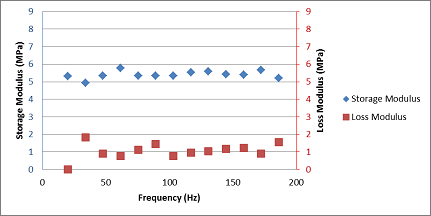
NanoDMA to determine storage and loss modulus for silicon rubber at varying frequency

Silicone Rubber 1

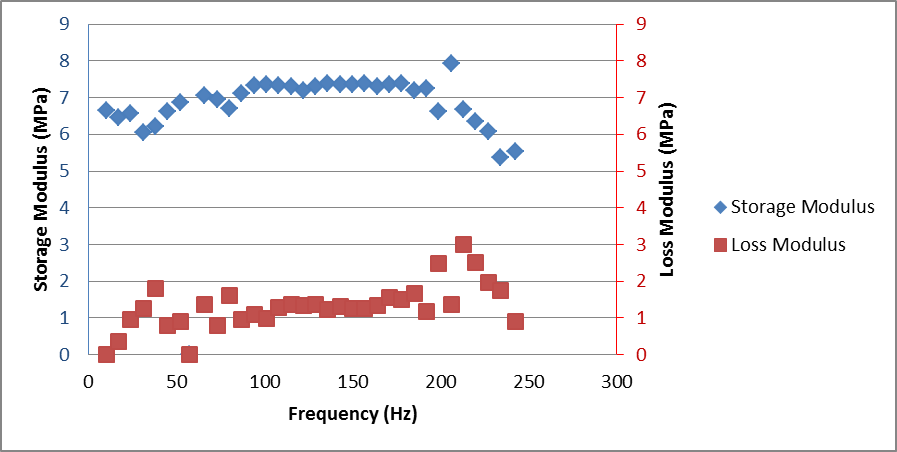
NanoDMA to determine storage and loss modulus for silicon rubber at varying frequency

Silicon Rubber 2

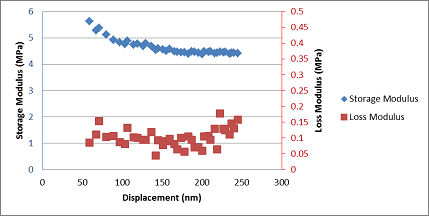
NanoDMA to determine storage and loss modulus for polycarbonate at varying displacement

Polycarbonate


Applications

Complex ModulusCompressionControlled Force/Strain Rate
Creep ComplianceEquilibrium Recoverable ComplianceFilm Analysis
Frequency EffectGlass TransitionIsostrain
Loss ModulusMulti-FrequencyRelaxation Modulus
Sample StiffnessSecondary TransitionsStatic/Dynamic Force
Storage ModulusStorage/Loss ComplianceStress Relaxation
Stress/Strain BehaviorTan DeltaViscoelastic Characterization

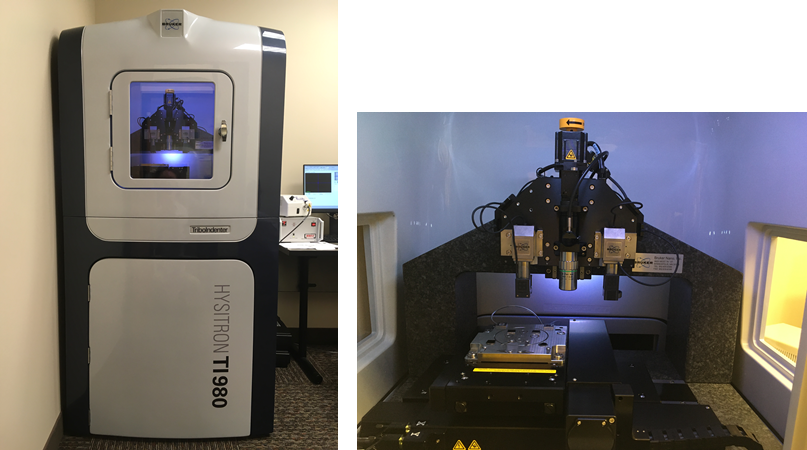
Instrument: Bruker Hysitron TI-980

Bruker Hysitron TI-980 in laboratory

Instrument Key Specifications

Max Dynamic Force Amplitude5 mN
Max Dynamic Displacement Amplitude2.5 um
Displacement Resolution0.02 nm
Force Range30 nN to 10 mN
Force Resolution1 nN
Frequency Range0.1 to 300 Hz
AtmosphereOpen Air, Inert Gas

Instrument: Multi-Technique and Full-Feature Nanoindentation System

Multi-Technique and Full-Feature Nanoindentation System sample on stage

Instrument Key Specifications

Temperature Range5 to 300 °C
Displacement Resolution0.02 nm
Force Range30 nN to 10 mN
Force Resolution1 nN
Frequency Range1 to 300 Hz
AtmosphereOpen Air, Inert Gas