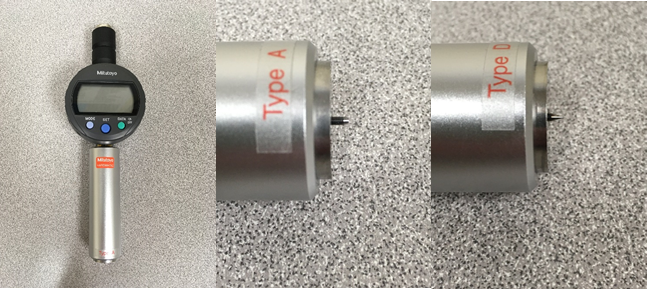
Shore hardness is a quick and easy way to measure a material’s hardness or resistance to indentation damage. Shore hardness is measured using a durometer, which is an instrument consisting of an indenter tip of known size attached to a calibrated force spring and read out display. The indenter tip protrudes 2.54 mm below the durometer’s flat presser foot. When the entire presser foot is in contact with a specimen’s surface, the indenter tip is pushed up into the durometer. The displacement the indenter tip gets pushed into the durometer reflects the hardness of the material, with higher displacements reflecting higher hardness.
Depending on the polymer of interest, different variations of Shore hardness testing is recommended. Shore hardness in fact is comprised of a family of scales, with each scale using a different indenter tip geometry and stiffness of force spring.
The most common scales in use are Shore A and Shore D. Shore A uses a truncated cone as an indenter tip and a lower stiffness spring to make it ideal for testing soft polymers like elastomers and silicones. Shore D uses a sharp conical point for its indenter tip and a higher stiffness spring to make it ideal for testing harder polymers such as cured epoxies or highly cross-linked materials.
Shore hardness testing has found use in molding and adhesive applications due to it being a quick way of determining how cured a polymer is. Assuming a fully cured polymer has a known hardness, and any measured hardness below that nominal means the polymer has not fully cured.
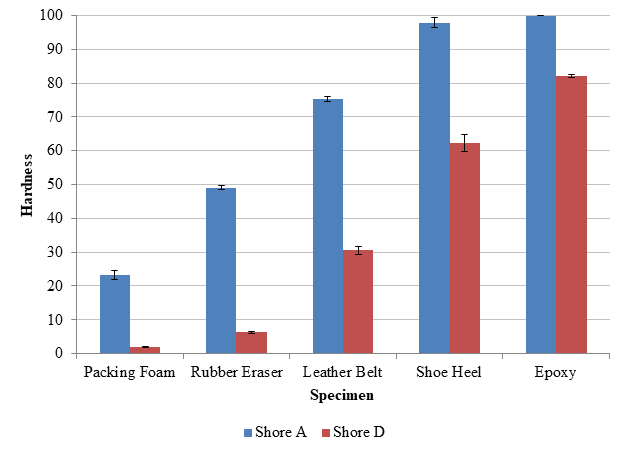
Typical Experimental Results

Applications
| Aging Studies | ASTM D2240 | Automotive | Biomedical Samples |
| Castor Wheels and Bearings | Coating Hardness | Contamination Control | Elastomers |
| Epoxy | Failure Analysis | Hard Coatings | Injection Molding |
| ISO 48-4 | O-Rings | Oxidative Damage | Plaster Cast |
| Polymers | Process Control | Protective Coatings | Roller Skate Wheels |
| Rubbers | Seals | Skateboard Wheels | Soft Coatings |
| Thermoforming | Thermoplastics | Thermosets | Tires |
| Urethanes | Viscoelastic Materials | Waxes | Weathering Studies |
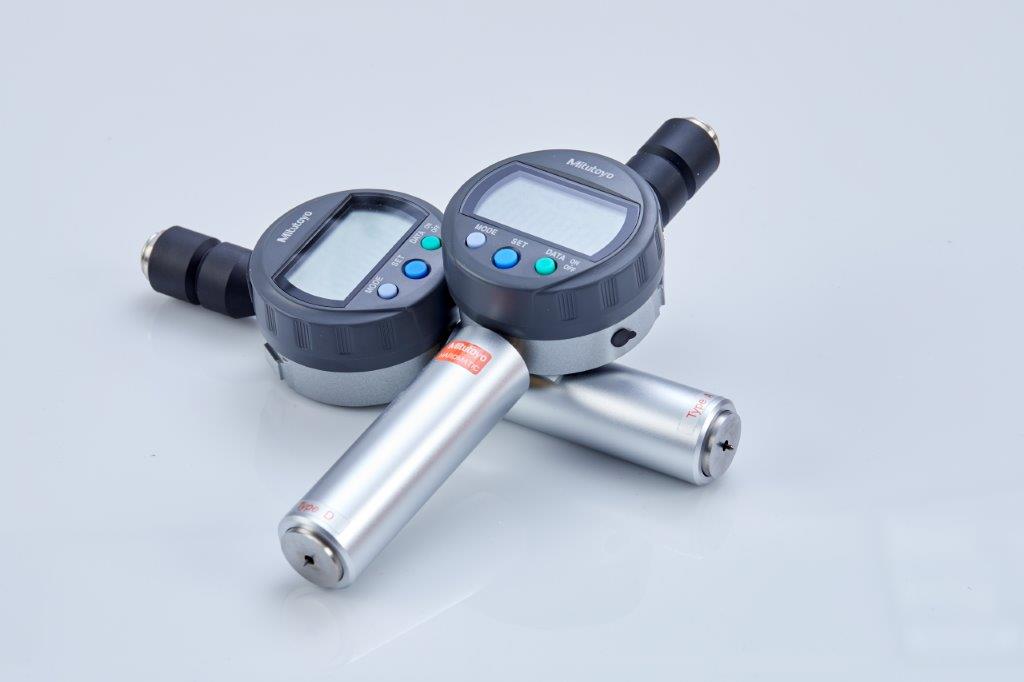
Instrument: Mituyo Shore A and Shore D Hardness Tester


Instrument Key Specifications
| Hardness Scale | Shore A Shore D |
| Indenter Type | Shore A: Truncated Cone Shore D: Conical Point |
| Tip Angle | Shore A: 35˚ Shore D: 30˚ |
| Tip Size | Shore A: 0.79 mm diameter Shore D: 0.1 mm radius |
| Range | Shore A: 10-90 Shore D: 20-90 |
| Resolution | Shore A: 0.1 Shore D: 0.1 |
| Testing Load | Shore A: 8.06 N Shore D: 44.64 N |
For more information, please see our application notes:
Shore Hardness of Household Materials, PDF
All application notes can be found here
ASTM Standards
| ASTM | Title | Website Link |
| D2240 | Standard Test Method for Rubber Property—Durometer Hardness | Link |
ISO Standards
| ISO | Title | Website Link |
| 48-4 | Rubber, vulcanized or thermoplastic — Determination of hardness — Part 4: Indentation hardness by durometer method (Shore hardness) | Link |
| 868 | Plastics and ebonite — Determination of indentation hardness by means of a durometer (Shore hardness) | Link |
| 7619-1 | Rubber, vulcanized or thermoplastic — Determination of indentation hardness — Part 1: Durometer method (Shore hardness) | Link |