Corrosion is a degradation process by which materials react with their environment. Corrosion causes the formation of oxide scale which can reduce the mechanical, thermal, or electrical properties of materials, especially metallic materials. Ebatco’s NAT Lab can analyze the surface and cross section of oxides formed on samples along with determining their microstructure. We can identify the function and distribution of alloying elements within materials and determine the effectiveness of protective coatings. Our expertise enables us to measure coating properties such as thickness, wear resistance, hardness, etc. and analyze the interactions that occur at coating and substrate interfaces.


Typical Experimental Results

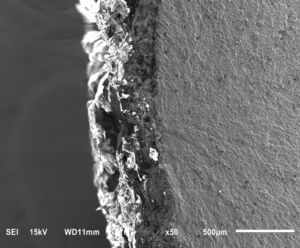
SEM Image of Titanium Vanadium coating

SEM image of a failed Ti-6Al-4V rod possessing a Titanium-Vanadium coating.

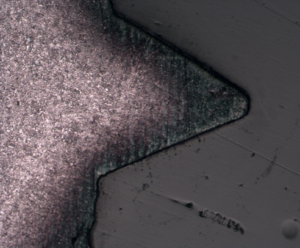
Optical microscopy of case hardened metal

Optical microscopy image of a case hardened metal fastener.

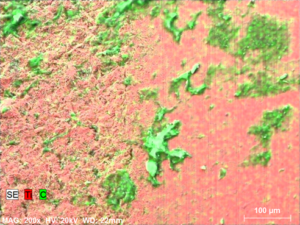
SEM/EDS of corroded metal titanium aluminum and vanadium

SEM/EDS image of a corroded Ti-6Al-4V dental implant’s surface.


Applications

AlloysChemical EtchingCase HardeningCarburizationCorrosion Analysis
Cross-Section AnalysisCrystal StructuresElement IdentificationFailure AnalysisForeign Material Identification
Forensic AnalysisFractographyFracture StudyGrainsGrain Boundaries
Grain GrowthGrain OrientationGrain SizeGrain StructureIC Failure Analysis
MaterialsMetalsMetallographyMetallurgyMicroscopy
MicrostructurePhase DiagramPenetration DepthSpectroscopySteels

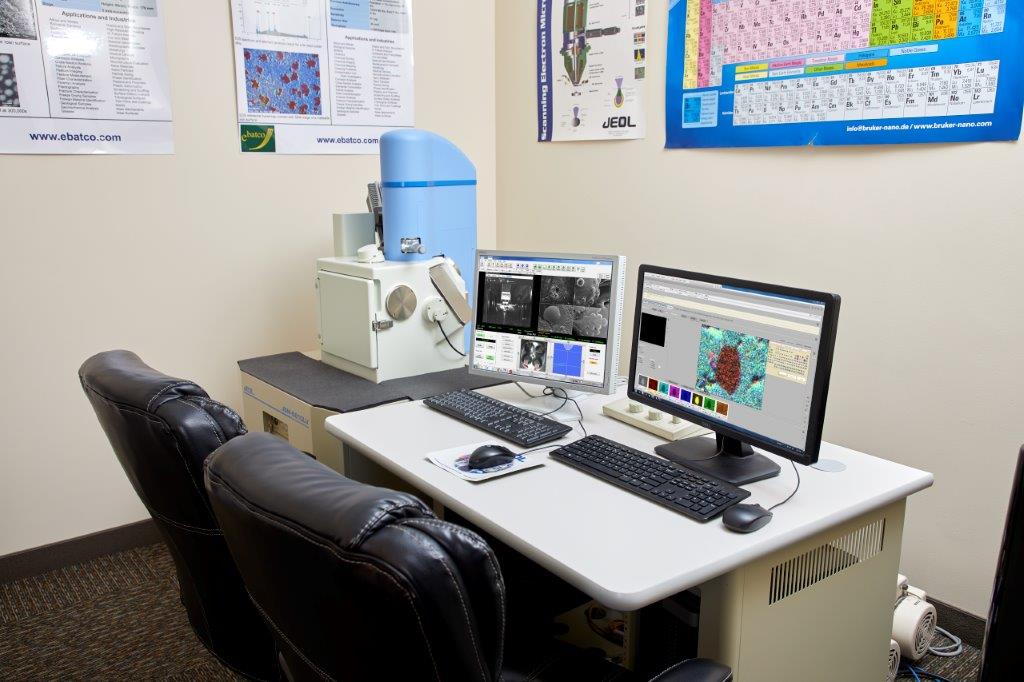
Instrument: JEOL 6610 LV Scanning Electron Microscope

JEOL 6610 LV Scanning Electron Microscope in laboratory

Instrument Key Specifications

FilamentW hairpin filament
ResolutionHigh Vacuum: 3nm (30kV),
8nm (3kV), 15nm (1kV)
Low Vacuum: 4 nm (30kV)
Accelerating Voltage300 V to 30 kV
Magnification5x to 300,000x
LV DetectorMulti-segment BSED
LV Pressure10 to 270 Pa
Sample SizesHeight: 80mm; Width: 178 mm
StageEucentric 5 axis motor control, asynchronous movement, x-y: 125mm-110mm, z: 5mm-8mm, tilt:-10 to 90 degrees, rotation: 360 degrees
Resolution5120 x 3840 pixels
Condenser LensZoom condenser lens
Objective LensConical objective lens


Compression Fracture of a Pellet Press Shaft

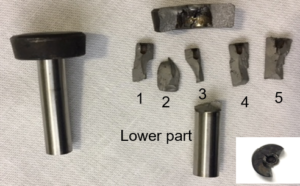
When parts break unexpectedly, determining the root cause is an important step in avoiding future problems. SEM fractography and composition mapping are excellent ways to determine the reasons behind part failures.  In this study, a shaft from a pellet press was examined after breaing during routine use.  Figure 1 shows the broken shaft compared to an intact shaft. The shaft broke into seven fragments and there was a small black hole at the top center of the shaft. The head of the shaft had a small protrusion which fit into the hole. The shaft was likely connected to the head by a welding or brazing process.

Pellet press components fractured and intact

Figure 1. Intact (left) and fractured (right) pellet press shafts.

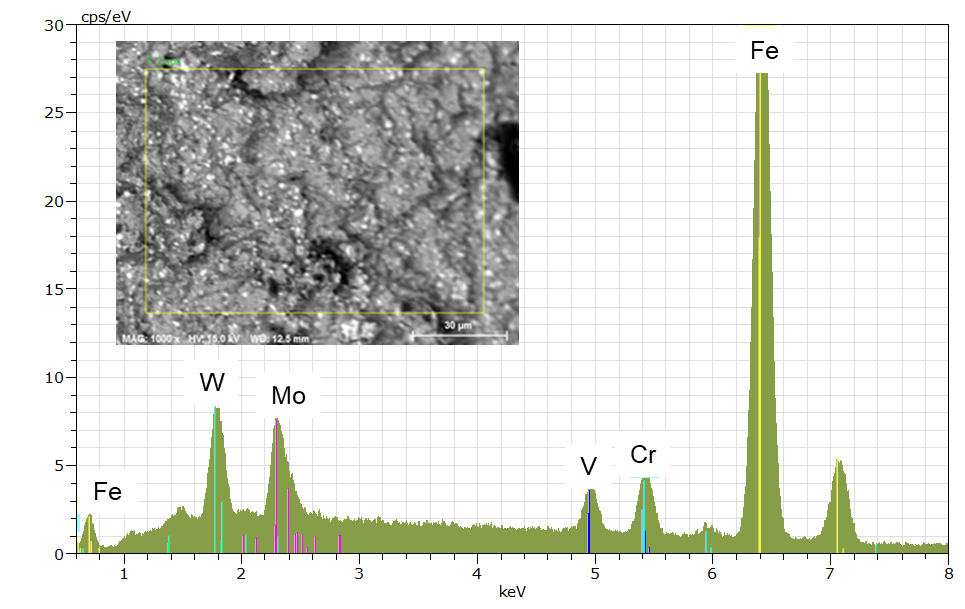
The composition of the shaft was analyzed by X-ray energy dispersive spectroscopy (EDS), the results of which are shown in Figure 2. The EDS spectrum indicates that the shaft was primarily composed of Fe, Cr, W, Mo and V, which are the most common elements used to create tool steels. The bright particles in the SEM image are W, Mo and V carbide particles added to limit the growth of cracks in the alloy and increase the mechanical strength of the material.

EDS spectra of fracture surface with SEM image

Figure 2. EDS spectrum of the fracture surface of the shaft. Inset: SEM image of the corresponding area.

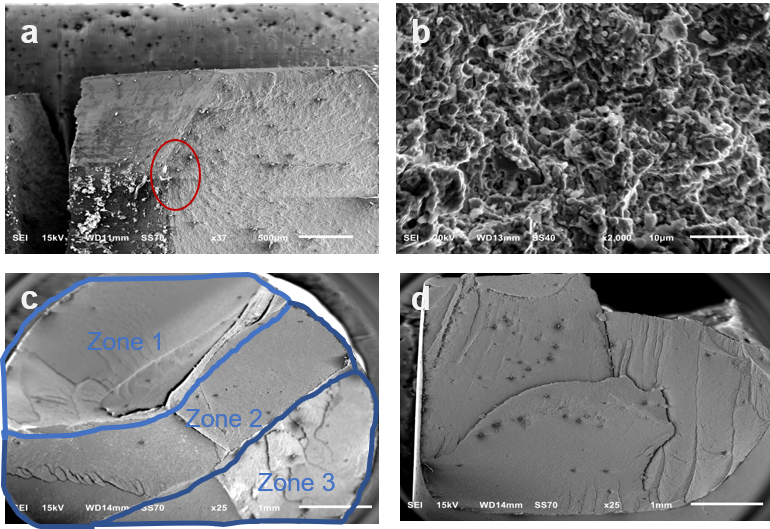
The microstructure of the compression fracture surface was investigated further using SEM (Figure 3). Figure 3a is the SEM image of fragment 5 from Figure 1. In fragment 5, chevron marks, or small lines which converge at the crack origination site. Chevron marks were not only observed in fragment 5, but also in fragments 1, 3, and 4. By tracing the chevron marks back, the fracture on fragment 5 originated from the bottom of the hole (red circle, Figure 3a). This location corresponds to the joint area between the shaft and the head, which is an area of high stress concentration. For this shaft fragment, several cracks initiated at the joint area, and the top part of the shaft broke into five pieces. After the crack initiated, the crack propagated downward at approximately 45º, which is the direction of highest shear stress. This also explains why fragment 2 had two slopes at about 45º angles (not shown).

A typical microstructure of the fracture surface at 2000X magnification is shown in Figure 3b.  Pieces 1 through 5 and the lower shaft had similar uneven and dimpled fracture surfaces, characteristic of ductile fracture. Some carbide particles were also found at the base of these dimples. The top view of the lower shafts’ fracture surface is shown in Figure 3c. Three unique areas were identified and labeled as zones 1, 2, and 3. Zone 1’s fracture surface has a cliff shape (Figure 3d). As shown in Figures 3c and 3d, cleavage lines formed on the fracture surface, demonstrating the growth direction of the cracks. Reassembling the fragments, fragment 2 fitted into zone 1, fragments 1 and 3 fitted into zone 2, and fragments 4 and 5 fitted into zone 3. The slopes on the fragments demonstrated that the cracks grew due to shear stress.

Microstructure of fractured surfaces for crack propagation analysis

Figure 3. Fracture surface microstructures. a) SEM image of fragment 5, b) Typical microstructure of the fracture surface at 2000x, c) Top view of the fracture surface on the lower shaft, d) Zone 1 fracture surface.

Based on morphological analysis, the fracture was identified as a ductile compression fracture. The cracks initiated at the joint area between the shaft and the head, and grew along the highest shear stress direction. The size and distribution of the carbide particles were homogenous. No large carbide segregation was observed at the critical areas. The failure of the shaft was due to an overload of compressive force.


ASTM Standards

ASTMTitleWebsite Link
A262Standard Practices for Detecting Susceptibility to Intergranular Attack in Austenitic Stainless SteelsLink
A763Standard Practices for Detecting Susceptibility to Intergranular Attack in Ferritic Stainless SteelsLink
A802Standard Practice for Steel Castings, Surface Acceptance Standards, Visual ExaminationLink
B487Standard Test Method for Measurement of Metal and Oxide Coating Thickness by Microscopical Examination of Cross SectionLink
B578Standard Test Method for Microhardness of Electroplated CoatingsLink
B748Standard Test Method for Measurement of Thickness of Metallic Coatings by Measurement of Cross Section with a Scanning Electron MicroscopeLink
E1077Standard Test Methods for Estimating the Depth of Decarburization of Steel SpecimensLink
E1508Standard Guide for Quantitative Analysis by Energy-Dispersive SpectroscopyLink
E3Standard Guide for Preparation of Metallographic SpecimensLink
E340Standard Test Method for Macroetching Metals and AlloysLink
E381Standard Method of Macroetch Testing Steel Bars, Billets, Blooms, and ForgingsLink
E384Standard Test Method for Microindentation Hardness of MaterialsLink
E407Standard Practice for Microetching Metals and AlloysLink
E7Standard Terminology Relating to MetallographyLink
F2328Standard Test Method for Determining Decarburization and Carburization in Hardened and Tempered Threaded Steel Bolts, Screws, Studs, and NutsLink

ISO Standards

ISO

TitleWebsite Link

9220

Metallic coatings — Measurement of coating thickness — Scanning electron microscope method

Link

5949

Tool steels and bearing steels — Micrographic method for assessing the distribution of carbides using reference photomicrographs

Link

4499-4

Hardmetals — Metallographic determination of microstructure — Part 4: Characterisation of porosity, carbon defects and eta-phase content

Link

4499-1

Hardmetals — Metallographic determination of microstructure — Part 1: Photomicrographs and description

Link

3887

Steels — Determination of the depth of decarburization

Link

26146

Corrosion of metals and alloys — Method for metallographic examination of samples after exposure to high-temperature corrosive environments

Link

18203

Steel — Determination of the thickness of surface-hardened layers

Link

11845

Corrosion of metals and alloys — General principles for corrosion testing

Link

11463

Corrosion of metals and alloys — Evaluation of pitting corrosion

Link

10271Dentistry — Corrosion test methods for metallic materials

Link