Metallic powders have been consistently used in powder metallurgy (PM), 3D-printing, solder for printed circuit boards, and other industries. The composition and particle size of these powders is critical for their processability and end use application. Uniform particle size facilitates homogenous melting, good interlayer bonding, improved mechanical properties and enhanced surface finish. Ebatco’s NAT Lab has a Beckman Coulter LS 13 320 Laser Diffraction Particle Size Analyzer and a Beckman Coulter Multisizer 4 which can measure particle concentration and size distribution respectively. Our SEM/EDS capabilities also allows us to analyze the microstructure and morphology of metallic powders. Lastly, we can use our STA 449 F3 Jupiter Thermal Analyzer to determine phase transformations that can occur within these metallic powders up to 1650 ºC.


Typical Experimental Results

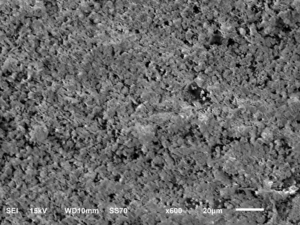
Gold (Au) powder SEM images at low magnification

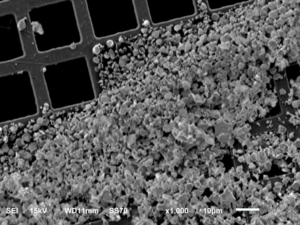
Gold (Au) powder SEM images at low magnification

SEM images of a fine gold powder.


Applications

3D PrintingAgglomeratesAggregatesAlloysCrystal Structures
Element DistributionFailure AnalysisForeign Material IdentificationForensic AnalysisFractography
Fracture StudyGrainsGrain BoundariesGrain GrowthGrain Orientation
Grain SizeGrain StructureIC Failure AnalysisMaterialsMetals
MetallographyMicroscopyMicrostructureParticle DistributionParticle Size
Phase DiagramPowder FlowPowder MetallurgySelective Laser SinteringSurface Finish

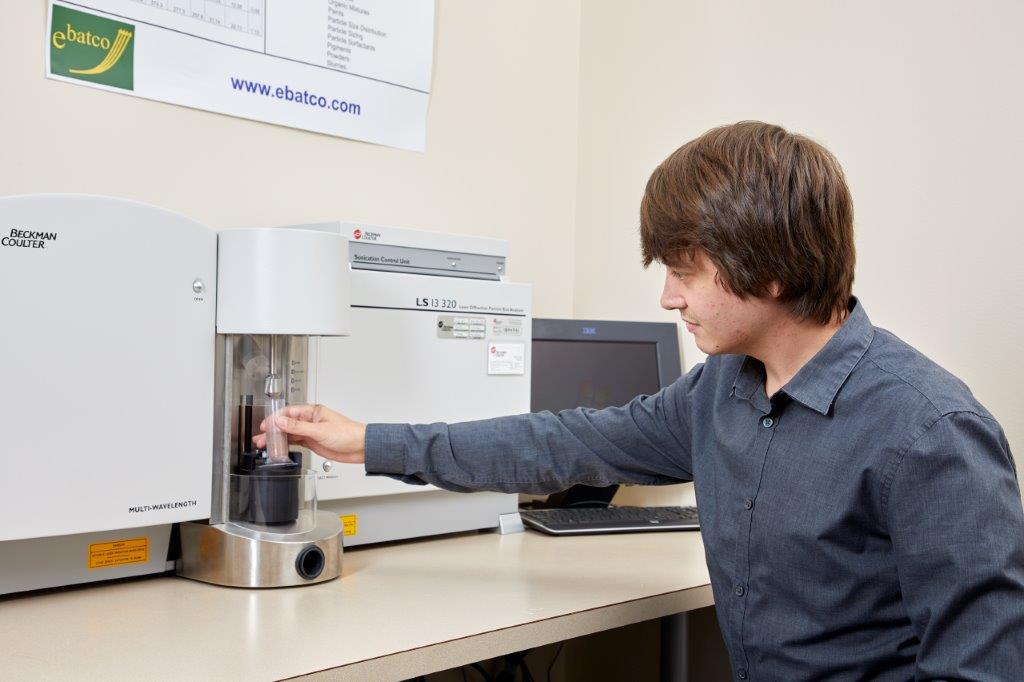
Instrument: Beckman Coulter LS 13 320 Laser Diffraction Particle Size Analyzer with ULM and Sonication Control Unit connected

Instrument Key Specifications

FilamentW hairpin filament
ResolutionHigh Vacuum: 3nm (30kV),
8nm (3kV), 15nm (1kV)
Low Vacuum: 4 nm (30kV)
Accelerating Voltage300 V to 30 kV
Magnification5x to 300,000x
LV DetectorMulti-segment BSED
LV Pressure10 to 270 Pa
Sample SizesHeight: 80mm; Width: 178 mm
StageEucentric 5 axis motor control, asynchronous movement, x-y: 125mm-110mm, z: 5mm-8mm, tilt:-10 to 90 degrees, rotation: 360 degrees
Resolution5120 x 3840 pixels
Condenser LensZoom condenser lens
Objective LensConical objective lens


Microporosity Measurement of Zn-Al Casting by Quantitative Image Analysis

With the development of computer technology, quantitative software image analysis has become feasible. Computer software can count grain and particle size, identify nonmetallic inclusions, and calculate porosity more efficiently than traditional manual methods. In this app note, the micro porosity of a Zn-Al casting is measured to demonstrate how the quantitative image analysis works.

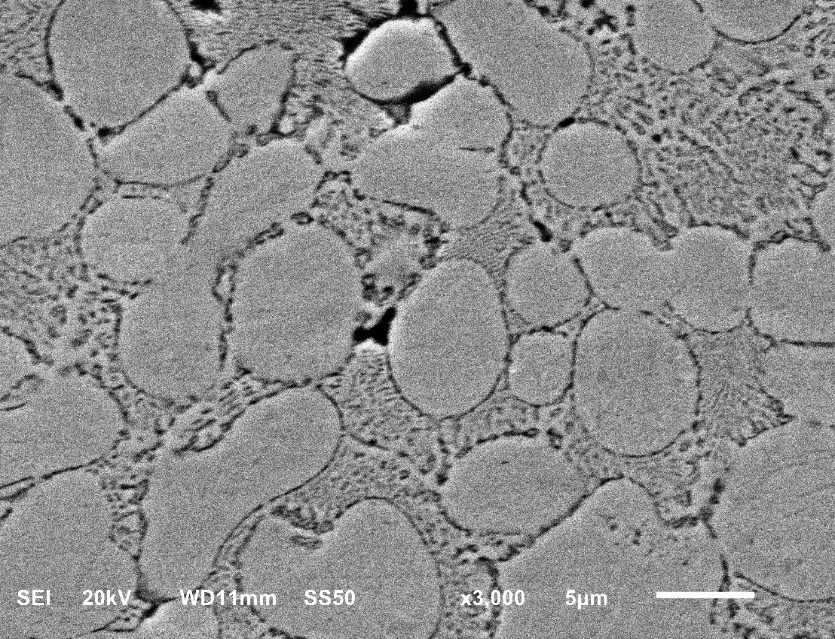
Zinc Aluminum alloy microstructure with SEM imaging

Figure 1. Typical microstructure of the Zn-Al alloy

Figure 1 shows the typical microstructure of a Zn-Al alloy. The alloy is composed of a lamellar eutectic α phase (dendrite network) and a zinc-rich η phase. In cast zinc, Al can refine the grain size and form a fine equiaxed grain structure. This can improve the strength, ductility, and toughness of zinc castings. Tiny holes form between the arms of the dendritic network due to gas evolution during the solidification process. In this sample, the relatively large pores are shrinkage cavities, which are more or less fissured and cave like in shape. It is impossible to completely remove shrinkage cavities in Zn-Al castings.

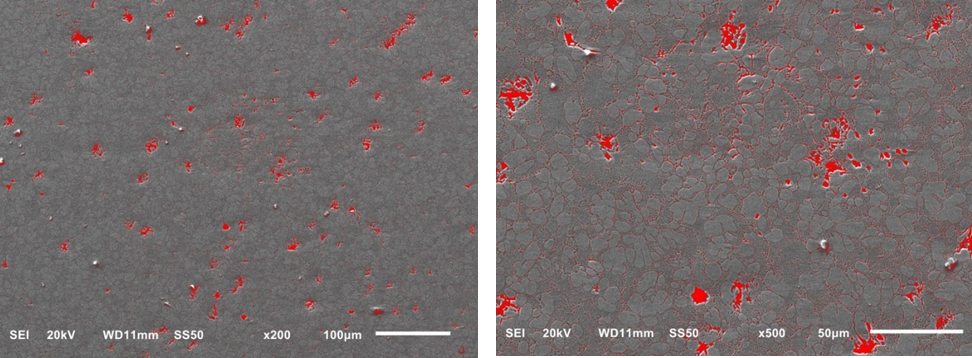
In this work, pores larger than 5 µm were selected for porosity measurement. Based upon practical applications or customer requirements, different pore sizes can be selected to calculate the porosity of the casting. To determine the effects of image magnification on porosity measurement, 200X and 500X micrographs are compared. For each magnification, five random areas were selected to measure the porosity of the casting. Figure 2 shows a typical distribution of pores within the Zn-Al casting.

Porosity measurements through scanning electron microscopy of metallic powders

Figure 2. Typical porosity measurement results using 200X (left) and 500X (right) magnification. (Pore sizes less than 5 µm were excluded from statistical calculations.)

Table 1 lists the porosity measurements with 200X and 500X magnifications. Based upon the results of the image analysis software, the average pore areas measured at 200X and 500X magnifications were very similar, around 19.74 µm2. The porosities (or percentage of the total image area occupied by pores) were consistent when measured at 200X and 500X magnification.

Table 1. Porosity measurement results with different magnifications

 200X Magnification500X Magnification
AreaAverage size (µm2)Percent area (%)Average size (µm2)Percent area (%)
Area 119.800.9817.911.38
Area 218.761.1321.421.36
Area 323.951.3724.720.97
Area 418.780.9220.651.15
Area 517.510.7513.930.86
Average19.761.0319.721.15

ASTM Standards

ASTMTitleWebsite Link
A892Standard Guide for Defining and Rating the Microstructure of High Carbon Bearing SteelsLink
B276Standard Test Method for Apparent Porosity in Cemented CarbidesLink
B487Standard Test Method for Measurement of Metal and Oxide Coating Thickness by Microscopical Examination of Cross SectionLink
B578Standard Test Method for Microhardness of Electroplated CoatingsLink
B657Guide for Metallographic Identification of Microstructure in Cemented CarbidesLink
B748Standard Test Method for Measurement of Thickness of Metallic Coatings by Measurement of Cross Section with a Scanning Electron MicroscopeLink
B796Standard Test Method for Nonmetallic Inclusion Content of Powders Intended for Powder Forging (P/F) ApplicationsLink
E1508Standard Guide for Quantitative Analysis by Energy-Dispersive SpectroscopyLink
E2651Standard Guide for Powder Particle Size AnalysisLink
E3Standard Guide for Preparation of Metallographic SpecimensLink
E384Standard Test Method for Microindentation Hardness of MaterialsLink
E407Standard Practice for Microetching Metals and AlloysLink
E45Standard Test Methods for Determining the Inclusion Content of SteelLink
E562Standard Test Method for Determining Volume Fraction by Systematic Manual Point CountLink
E768Standard Guide for Preparing and Evaluating Specimens for Automatic Inclusion Assessment of SteelLink
E930Standard Test Methods for Estimating the Largest Grain Observed in a Metallographic Section (ALA Grain Size)Link

ISO Standards

ISOTitleLink
9220Metallic coatings — Measurement of coating thickness — Scanning electron microscope methodLink
643Steels — Micrographic determination of the apparent grain sizeLink
5949Tool steels and bearing steels — Micrographic method for assessing the distribution of carbides using reference photomicrographsLink
4499-4Hardmetals — Metallographic determination of microstructure — Part 4: Characterisation of porosity, carbon defects and eta-phase contentLink
4499-1Hardmetals — Metallographic determination of microstructure — Part 1: Photomicrographs and descriptionLink
18203Steel — Determination of the thickness of surface-hardened layersLink