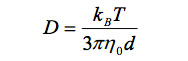
Particles suspended in liquids are in Brownian motion due to random collisions with solvent molecules. This motion causes the particles to diffuse through the medium. The diffusion coefficient, D, is inversely proportional to the particle size according to the Stokes-Einstein equation:

Stokes Einstein equation using diffusion constant, Boltzmann's constant, absolute temperature, viscosity, and spherical particle diameter

Where D is the diffusion constant, kB the Boltzmann’s constant, T the absolute temperature, ƞ0 the viscosity, d the spherical particle diameter. Photon Correlation Spectroscopy (PCS), also referred to as dynamic light scattering, is a technique used to determine the diffusion coefficient of small particles in a liquid. The coefficient is determined by accurately measuring the light scattering intensity of the particles as a function of time. Photon correlation spectroscopy is a proven technique for particle size analysis of sub nano meter to a few micron particles.


Typical Experimental Results

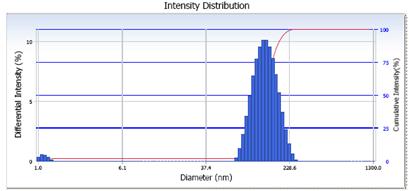
Particle size analysis using dynamic light scattering

Particle size analysis of a particle in solution


Applications

Brownian MotionContamination of SolutionEffect of Additives
Electrophoretic Light ScatteringOrganic MixturesParticle Suspensions
pH AnalysispH TitrationPhoto Correlation Spectroscopy
Polishing SlurriesSedimentationTemperature Testing

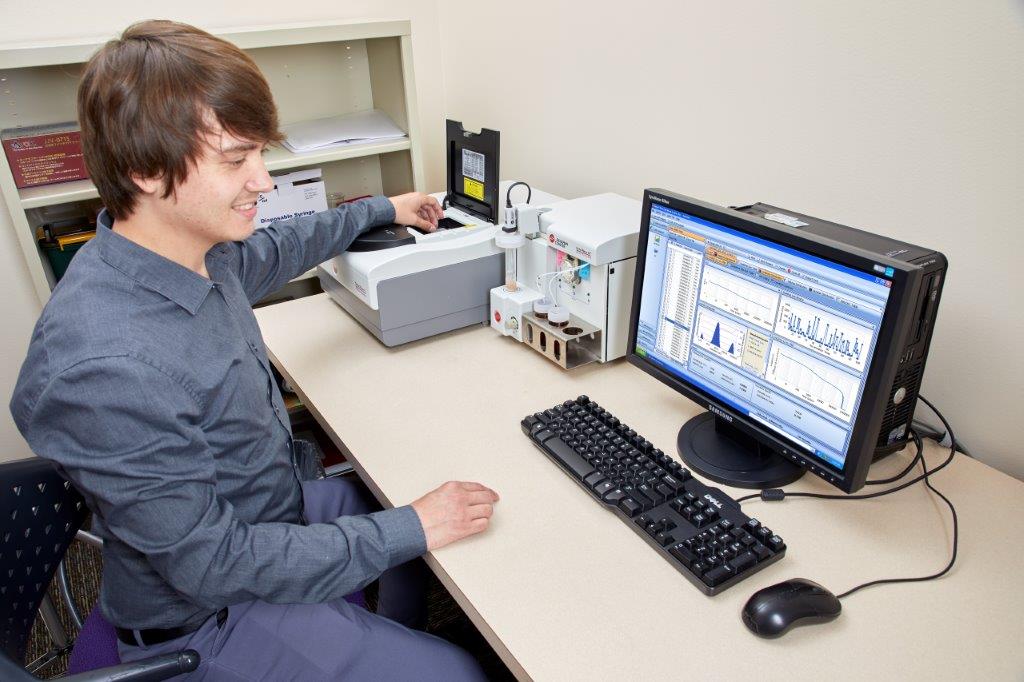
Instrument: Beckman Coulter Delsa Nano C Particle Analyzer

Beckman Coulter Delsa Nano C Particle Analyzer in laboratory
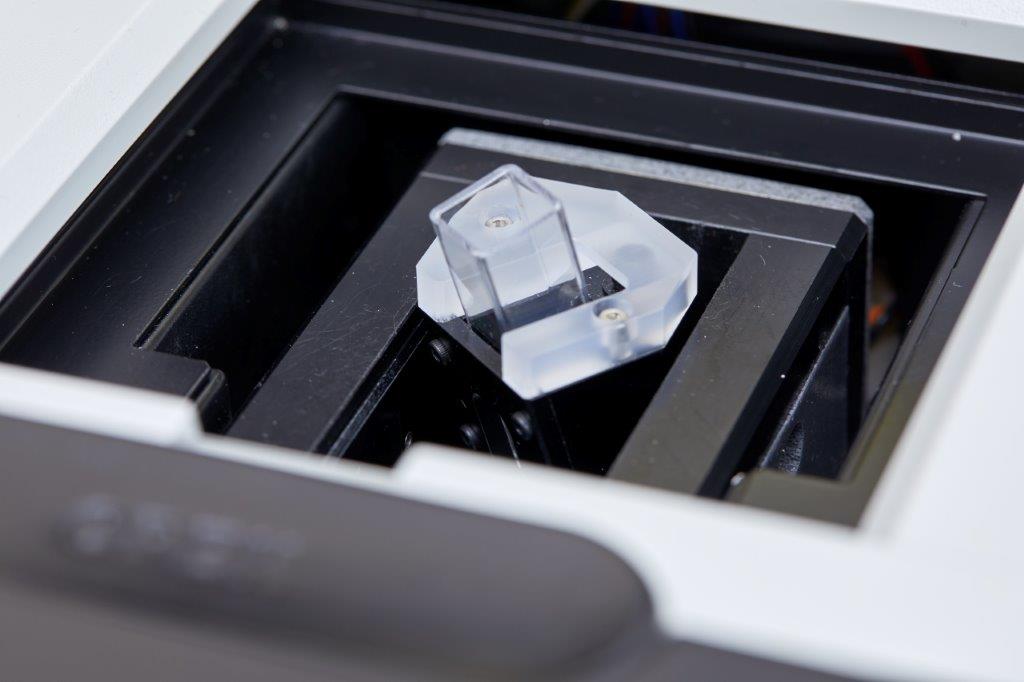
Size cell for particle sizing measurements

Instrument Key Specifications

Measurable Size Range0.6nm – 7µm
Concentration Range0.001% – 40%
Maximum Heating Temp90°C
Maximum Cooling Temp15°C below ambient temp
pH Range1-13
Scattering Angle15°, 30°, 160°
Size Cell Sample Requirements0.9mL
Flow Cell Sample Requirements0.7mL
High Concentration Cell Sample Requirements1mL

Dynamic Light Scattering


Nanoparticle Sizing through Dynamic Light Scattering

Particles suspended in liquids are in Brownian motion due to random collisions with solvent molecules. This motion causes the particles to diffuse through the medium. The diffusion coefficient, D, is inversely proportional to the particle size according to the Stokes-Einstein equation:

Stokes Einstein equation using diffusion constant, Boltzmann's constant, absolute temperature, viscosity, and spherical particle diameter

Where D is the diffusion constant, kB the Boltzmann’s constant, T the absolute temperature, ƞ0 the viscosity, d the spherical particle diameter. Photon Correlation Spectroscopy (PCS), sometimes also referred as dynamic light scattering, is a technique used to determine the diffusion coefficient of small particles in a liquid. The coefficient is determined by accurately measuring the light scattering intensity of the particles as a function of time. As the particles of interest diffuse through the sample cell due to Brownian motion, an incident beam of laser light illuminates the particles. The particles scatter the light, producing fluctuations in the scattering intensity as a function of time. The scattered light is collected at a chosen angle, and is measured by a highly sensitive detector. Since the diffusion rate of particles is determined by their size, information about their size is contained in the rate of fluctuation of the scattered light. The intensity fluctuations are collected as photon counts and correlated to generate the auto correlation function (ACF). The diffusion coefficient is determined by fitting the ACF using the Cumulants method from which the mean size is obtained using the Stokes-Einstein equation.

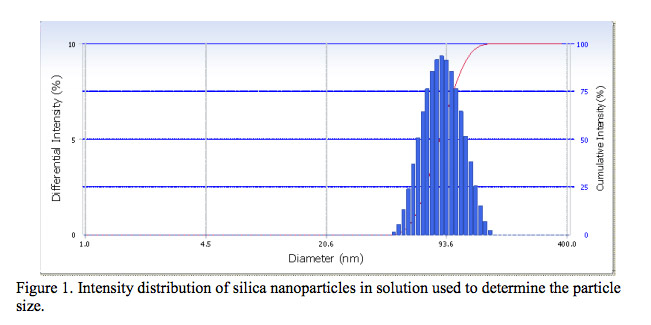
Intensity distribution determined from Cumulants method and Stokes Einstein

The particle sizing tests can be performed on a Delsa Nano C Nanoparticle Size and Zeta Potential Analyzer available in Ebatco’s Nano Analytical and Testing Laboratory (NAT Lab). The Delsa Nano C utilizes Photon Correlation Spectroscopy and Electrophoretic Light Scattering techniques to determine particle size and zeta potential of materials. Offering an excellent degree of accuracy, resolution and reproducibility, the Delsa Nano C has been designed to simplify submicron particle size and zeta potential analyses. The Delsa Nano C provides accurate size measurements in the range from 0.6 nm to 7 μm with sample concentration ranging from 0.001% to 40%. It can perform the analysis of aqueous and non-aqueous samples as well as Zeta potentials of solid surfaces and membranes. The system is also equipped with a temperature control unit and an auto titrator to facilitate the study of temperature and pH value influences on particle size and agglomeration.

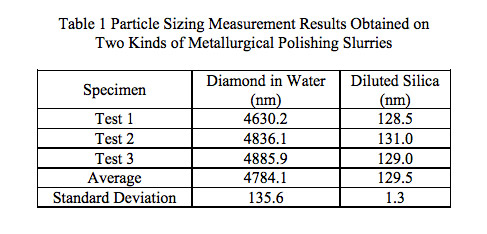
Particle sizing measurements for diamond in water and diluted silica

Particle size is a key characteristic in fields where size control is necessary. For example, polishing slurries can be used to create ultra smooth surfaces. Large polishing particles can either create large unwanted scratches or not polish at all if the particle size is not controlled. Particle sizing can also be used to monitor the dispersion of drugs in pharmaceuticals. Particle sizing using dynamic light scattering or PCS has been serving a wide variety of applications in industries such as nanotechnology, electronics, pharmaceuticals, inks, food and beverage, biomedical, and textile.

Figure 1 and Table 1 are the measurement results obtained on two kinds of metallurgical polishing slurries using the Delsa Nano C Nanoparticle Size and Zeta Potential Analyzer.


ISO Standards

ISOTitleWebsite Link
22412Particle size analysis– Dynamic light scattering (DLS)Link
15900Determination of particle size distribution– Differential electrical mobility analysis for aerosol particlesLink