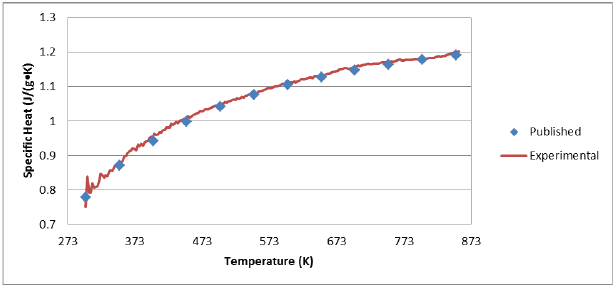
Specific heat capacity or specific heat under constant pressure (Cp) is the amount of heat required to raise the temperature of one gram of a substance by one degree Celsius. Specific heat is an important value that can be used to determine the amount of heat or energy transferred between a system and its surroundings. The specific heat of a substance is an intensive property of that substance, meaning it does not depend on the size or volume of that substance. If mass and specific heat of a substance are known, then the change in the substance’s temperature (ΔT) will reflect the amount of heat (q) absorbed or released in a particular process following the relationship: q = (mass of the substance)(Cp)(ΔT).
Typical Experimental Results

Applications
|
Adsorption
|
Catalytic Reactions
|
Compositional Analysis
|
|
Corrosion/Oxidation
|
Crystallization
|
Curing
|
|
Decomposition Reactions
|
Differential Scanning Calorimetry
|
Evaporation
|
|
Glass Transition Temperature
|
Magnetic Transitions
|
Mass Changes
|
|
Phase Diagrams
|
Phase Transition Temperatures
|
Purity Determination
|
|
Reaction Kinetics
|
Residual Mass
|
Simultaneous Thermal Analysis
|
|
Solid-Gas Reactions
|
Solid-Liquid Reactions
|
Solid-Solid Reactions
|
|
Specific Heat Determination
|
Sublimation
|
Synthesis Reactions
|
|
Thermal Stability
|
Thermogravimetric Analysis
|
Transition Enthalpies
|
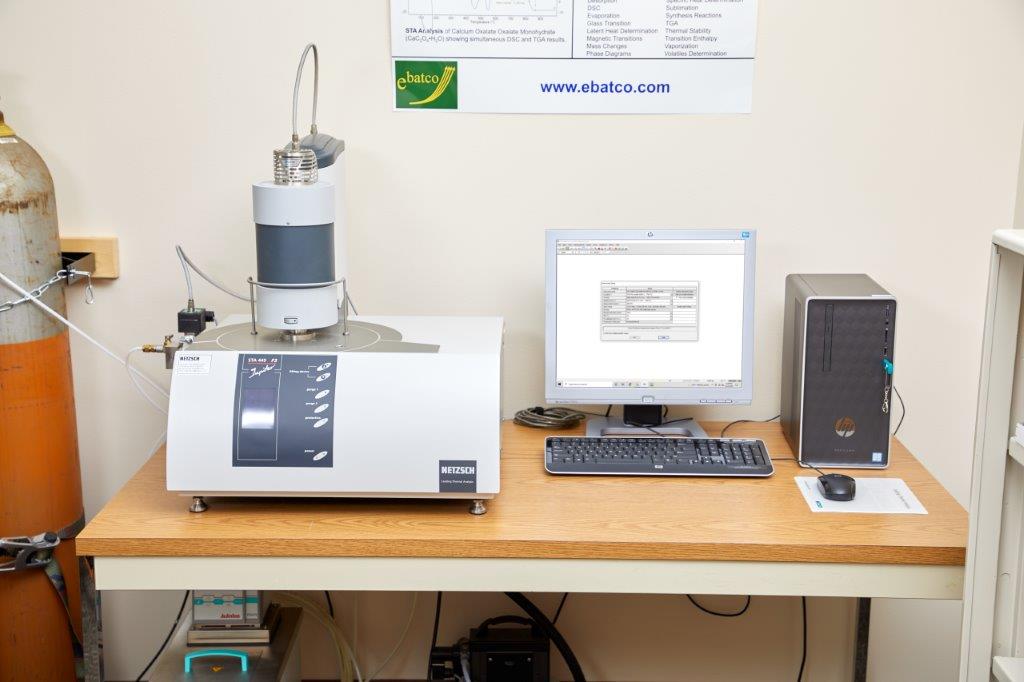
Instrument: STA 449 F3 Jupiter Thermal Analyzer


Instrument Key Specifications
| Temperature Range | RT-1650°C |
| Temperature Sensitivity | 1.5°C or .25% whichever is greater |
| Reproducibility | within 0.3°K |
| Load Balance Range | 35g |
| Balance Sensitivity | 1 μg |
| Drift | <5 μg/hr |
| Accuracy | ±5% |
| Environmental Control | Oxidative, Reducing, or Inert Atmosphere |
For more information, please read our application notes:
All application notes can be found here