Porometry employs the usage of a wetting fluid of known surface tension and a miniscule contact angle. The typical wetting fluid, Porofil, fully wets a variety of sample surfaces. Unlike porosimetry, porometry does not require a vacuum environment or mercury to measure pore size. Porometry measurement with a porometer can analyze any material with through pores and can characterize the pore number, pore size, pore density, bubble point and gas/liquid permeability.


Typical Experimental Results

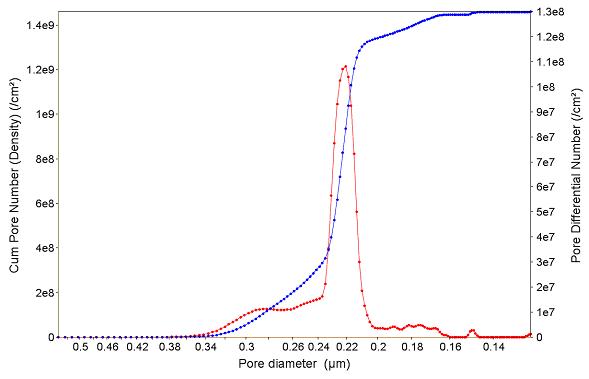
Cumulative and differential pore number for a thin film membrane

Cumulative and differential pore number for a thin film membrane

Pore Size Analysis of Two Membrane Samples

Parameters
Membrane A
Membrane B
Maximum Pore Size (µm)0.52361.8547
Mean Flow Pore Size (µm)0.22640.1495
Minimum Pore Size (µm)0.13740.1026
Bubble Point Pressure (bar)1.22240.3451
Bubble Point Flow Rate (L/min)0.06870.0418
Pore Density (cm ^-2)1.46×10 ^94.25×10 ^9
Initial Contact Angle (°)79.272.2
Contact Angle After 20s (°)72.655.8
Zeta Potential at pH 8 (mV)33.025-13.815

Applications

Biomedical Porous MaterialsBubble Point Flow RateBubble Point Pressure
FabricsFiltration MembranesGas/Liquid Permeability
Maximum Pore SizeMean Flow Pore SizeMeshes
Minimum Pore SizePapersPolymeric Membranes
Pore DensityPore NumberPore Volume
Porofil Wetting FluidSintered MaterialsThrough Pore Size

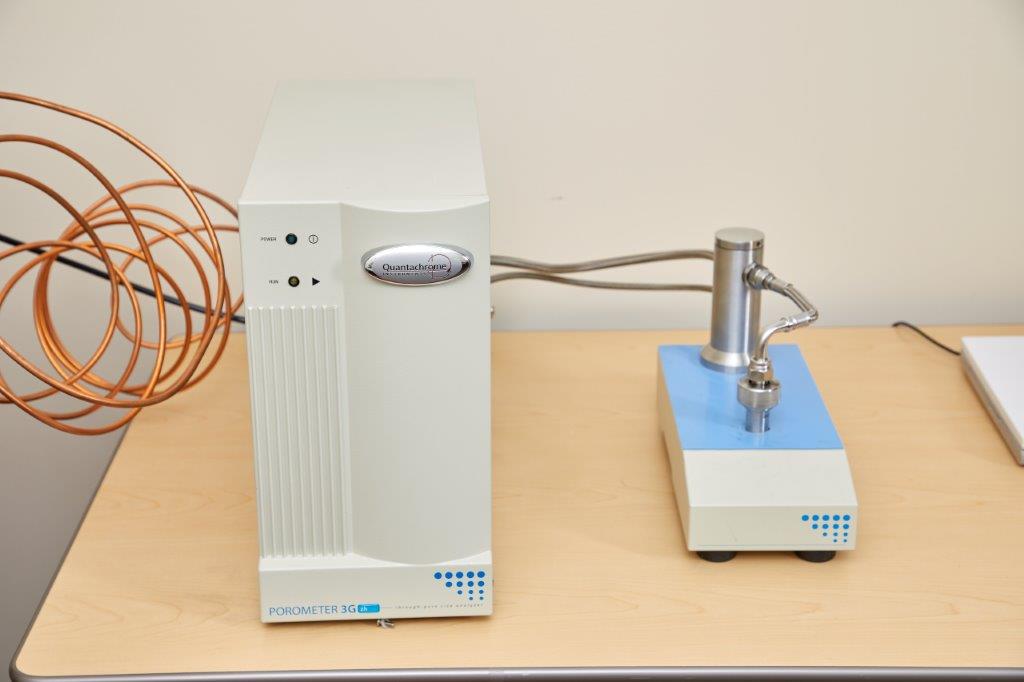
Instrument: Quantachrome Porometer 3G zh

Quantachrome Porometer 3G zh in laboratory

Instrument Key Specifications

Pore Size Range0.018 – 500µm
Pressure Range0.015 – 500psi
Pressure Controllers2
Pressure Sensors3
Flow Rate Range0-10L/min; 0-200L/min
Wetting FluidPorofil


Nano/micro Pore Size and Pore Size Distribution Measurement

Filtration systems rely on filters to remove unwanted materials and contaminants or allow only certain kinds of solutes to pass through in order to achieve separation purposes. It is obvious that pore size and its distribution are important parameters for a filtration material. These parameters can be measured by a porometer. The measuring technique is called porometry.

Pore size distribution from porometer

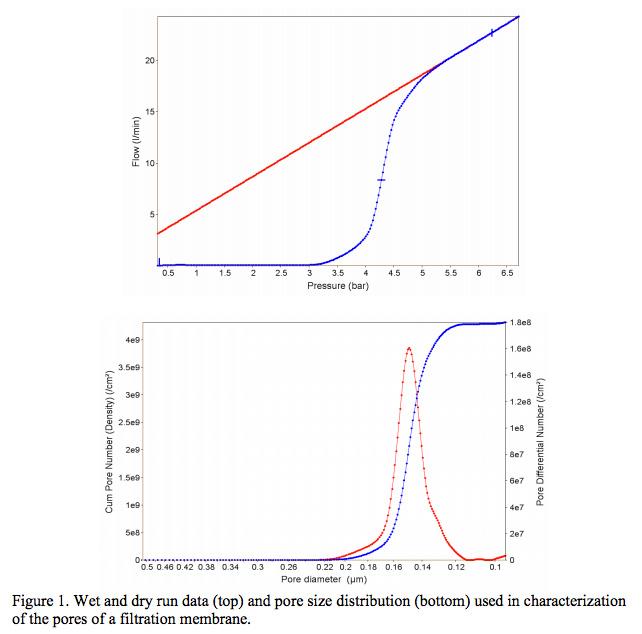
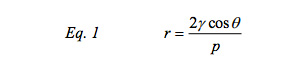
A porometer such as the one equipped in Ebatco’s Nano Analytical and Testing Laboratory (NAT Lab) is an instrument that is used for analyzing porosity characteristics of materials. In general, a porometer employs a liquid displacement technique to measure the pore size distribution of a sample (media/material). The sample is first thoroughly wetted with liquid of low surface tension and low vapor pressure such that all of the pores of the sample have been filled with the liquid. Then the wetted sample is subjected to an increasing pressure, applied by a gas source. As the pressure of gas increases, it will reach a point where it can overcome the surface tension of the liquid in the largest pores and will push the liquid out of the sample. Increasing the pressure still further allows gas to flow through smaller pores, until all of the pores have been emptied. By monitoring the pressure applied to the sample and the mass flow through the sample while the wetting liquid is being expelled, a ‘wet’ run is obtained for the sample. If the sample is then tested ‘dry’ without wetting fluid in its pores, a ‘dry’ run is obtained. By comparing the flows on the ‘wet’ run with those from the ‘dry’ run, the pore size distribution can be calculated using the following equation:

Pore size radius equation using surface tension, contact, angle, hydrostatic pressure

Where γ is the surface tension of the liquid, θ is the contact angle, p is the hydrostatic pressure and r is the radius of the pore.

An example of the wet (blue color curve) and dry (red color curve) runs and cumulative pore number (blue color curve) and differential pore number (red color curve) is shown in Figure 1. The properties that a porometer can measure on a filtration material include bubble point flow rate, bubble point pressure, maximum pore size, mean flow pore size, minimum pore size, pore size distribution, pore density, pore volume, pore surface area, and gas/liquid permeability.

Porometry is not limited to just for filtration materials. A porometer can be used to characterize virtually any porous materials with open pores such as biomedical porous materials, fabrics, fuel cell membranes, meshes, papers, sintered metals and ceramics. The pore sizes that our porometer can measure are from a few nanometers to 500 microns.


ASTM Standards

ASTMTitleWebsite Link
F316Standard Test Methods for Pore Size Characteristics of Membrane Filters by Bubble Point and Mean Flow Pore TestLink
E128Standard Test Method for Maximum Pore Diameter and Permeability of Rigid Porous Filters for Laboratory UseLink
E1294Standard Test Method for Pore Size Characteristics of Membrane Filters Using Automated Liquid PorosimeterLink
E1288Standard Test Method for the Durability of Biomass PelletsLink
D6767Standard Test Method for Pore Size Characteristics of Geotextiles by Capillary Flow TestLink