The Additive Manufacturing (AM) industry is expanding worldwide, and AM products are becoming increasingly common in commercial markets. Additive manufacturing is a process that can rapidly fabricate complex parts with the customization and design freedom that other manufacturing techniques can’t match. Polymer, metal, ceramic, and composite materials can be designed using different printing processes that result in a wide range of material properties. Understanding of these properties is important to ensure products will serve their intended purpose within the field.
Ebatco has the instrumentation to meet the challenges in the additive manufacturing field. Our lab services can help with development and verification of the material properties required for ideal production and performance for all AM parts. The scientists at Ebatco have the knowledge and expertise to meet the needs from raw material inspection, failure analysis, qualification and verification of finished goods, and more. The services provided will integrate seamlessly into your company’s workflow for process development or product verification.
Ebatco offers the micro- and nano- testing that your company needs to bring your prototypes into production or to maintain product quality. Our lab experts offer ISO/IEC 17025 accredited testing within our mechanical, chemical, thermal, liquids & particles, and surface & interface suites. If you have any questions about the services or instrumentation available at Ebatco, feel free to call or email and a member of our team will be able to further assist you.
Applications
| Analysis of anisotropic properties | Color and gloss appearance | Elemental distribution and mapping | Failure analysis | Hydrophobicity and hydrophilicity testing |
| Investigation of surface finish and roughness | Microstructure | Particle sizing of additive powders | Polymer compound identification | Porosity |
| Tensile, compression, and bending strengths | Thermal degradation and decomposition | Thermal properties and melting | Tribological friction and wear analysis | Wettability of surfaces |
For more information, please read our application notes:
3D Contouring via White Light Interferometry
Advancing, Receding and Roll-off Angle Measurements through Sliding Angle Method
Coating Scratch Resistance and Interfacial Adhesion Evaluation through Nanoscratch
Coefficient of Thermal Expansion Measurement using TMA
Fracture Failure Analysis of Steel Wire
Light Load Reciprocating Wear of Computer Hard Disk Coatings
Mapping Mechanical Properties of Additive Manufactured Products using XPM
Melting Temperature and Latent Heat of Fusion of Indium
Micro Contact Angle Measurements on Single Particles, Filaments and Patterned Surfaces
Nanoindentation for Hardness and Elastic Modulus Measurements at Nanoscale
Optical Inspection and Profiling of Defects on a Coated Wafer Surface
Porosity Measurement of Additive Manufactured Products using SEM
Quantitative Composition Determination of Powder Mixtures Using XRD
SEM EDS Analysis of Bicentennial Penny Patina
Simultaneous Thermal Analysis of the Decomposition of Calcium Oxalate
Specific Heat Capacity of Refractory Material
Thermogravimetric Analysis of Calcium Oxalate
Vickers Hardness Testing of Metallic and Ceramic Materials
All application notes can be found here
Mapping Mechanical Properties of Additive Manufactured Products using XPM
Additive Manufacturing (AM) allows for rapid and customized production in various industries, such as aerospace, automotive, medical, energy, and consumer products. The AM market is expanding rapidly, with the technology being easy to utilize with efficient optimization and customization. While additive manufacturing is often utilized for prototyping, a large portion of AM products are end-use and put on the market after production. There is a large appeal for using AM to tailor products for different customers, allowing industries such as medical devices, footwear, and fashion to have perfectly fitting products for people at reasonable costs. Aerospace, automotive, and energy industries can manufacture components that require high dimensional accuracy, quick turnaround time and unique properties unachievable through other manufacturing techniques.
To assess the quality and the processing conditions of AM products, knowledge of spatially resolved mechanical properties can be very important and informative. Accelerated Property Mapping (XPM) is a new nanoindentation method to measure the mechanical properties on a nano- and micro-scale. Accelerated property mapping utilizes a diamond tip to perform nanoindentation testing at speeds of up to 3 indents per second. Each indent generates a force-displacement curve, and with a known area function of the indenter tip, it can be used to determine reduced elastic modulus and nanohardness based on the Oliver and Pharr method. Arrays of these indents are used to generate maps of mechanical properties of large areas, called XPM maps.

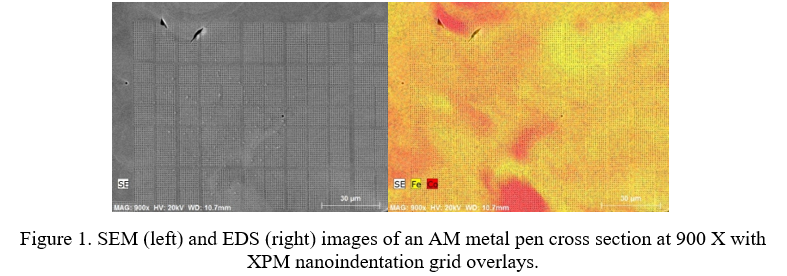
For this analysis, 10,800 indents, with 1 μm spacing between each, were performed on an AM metal pen cross-section to generate XPM maps. Figure 1 shows a Scanning Electron Microscopy (SEM) and an Energy Dispersive X-Ray Spectroscopy (EDS) image with nanoindentation grid overlays of the metal pen cross-section used for XPM testing. The left image in Figure 1 displays the morphology and the right image displays the elemental distributions for iron in yellow and cobalt in red. Other alloying elements that are present in the pen cross-section, like nickel, chromium, and silicon are not shown here for visual clarity. There are noticeably distinct regions with different morphologies and compositions in the pen cross-section. To assess how the morphology and composition influence mechanical properties, XPM analysis was employed.

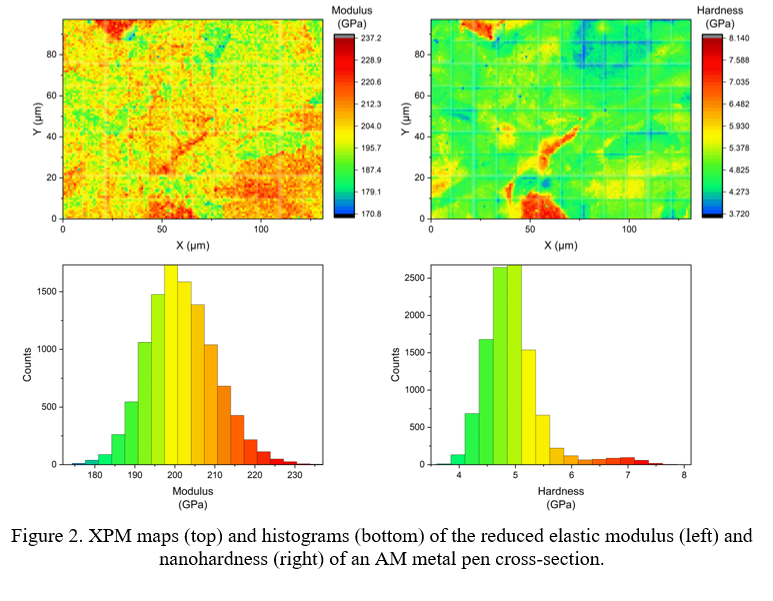
Figure 2 presents the XPM data for the reduced elastic modulus and nanohardness measured on the metal pen cross-section with the color maps showing regions where the reduced elastic modulus and nanohardness values are noticeably different. These maps correlate well with the morphology and elemental data shown in Figure 1. The Co-rich regions on the EDS map all have hardness values between 6.0 and 7.5 GPa, while Fe-rich regions have lower hardness values from 4.0 to 5.5 GPa. The differences in reduced elastic modulus are less noticeable between the two different kinds of element-rich regions, but the regions with higher modulus values still match Co-rich regions.
As illustrated above, accelerated property mapping (XPM) is a valuable tool for characterizing AM products. XPM performs nanoindentation tests at extraordinarily fast speeds and at high spatial resolutions to reveal mechanical property distributions at a nano-, micro-scale. It can be utilized to assess defects, impurities, inclusions, different phases, or compositional variability in additive manufactured products.