Ultraviolet-Visible-Infrared (UV-Vis-NIR) spectroscopy measures the absorption, reflection, and transmission spectrum of a material. It is used to characterize material properties such as optical density in polycarbonate lenses, molar extinction coefficient in metal-ligand compounds, and bandgap energy in quantum dots.

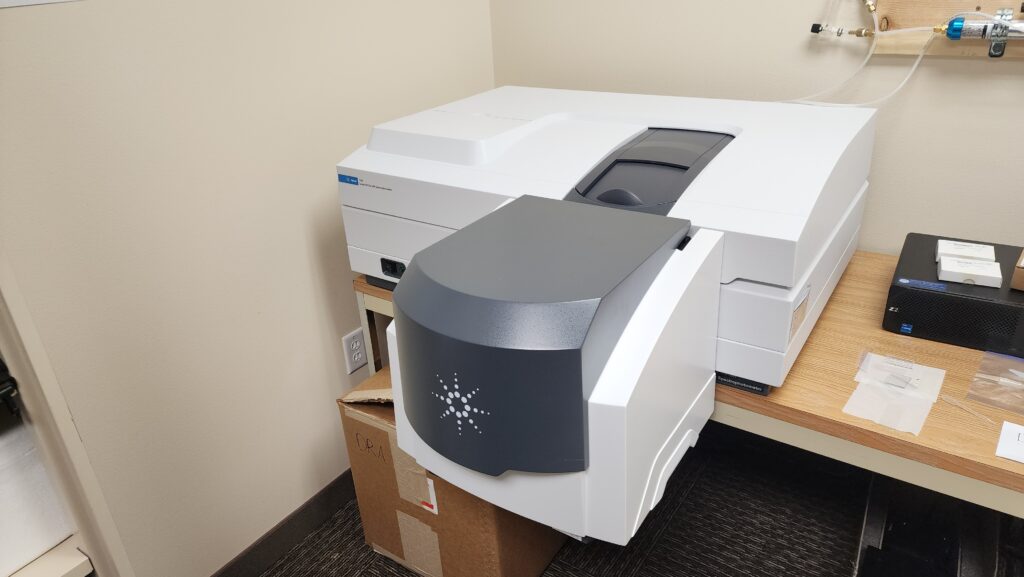
Ebatco’s Agilent Cary 7000 Universal Measurement Spectrophotometer (UMS) combined with a Diffuse Reflectance Accessory (DRA) is state-of-the-art when it comes to complete optical sample characterization. The base instrument is a double-beam spectrophotometer which accounts for light source intensity fluctuations and has a wavelength range of 175-3300 nm. In addition, the base instrument is capable of measuring up to an optical density of 10 Abs, meaning it can measure one part in 10 billion of transmitted light through a sample.

The Universal Measurement Accessory (UMA) allows for independent control of the sample angle and detection angle. The sample can be rotated a full 360° and the detector can be rotated around the sample from 10-350°. In addition, the input polarization can be tuned to S- or P-polarization, and any polarization in between. The UMA can achieve absolute reflectance, absolute transmittance, and absolute absorptance values at nearly any angle without having to touch the sample or beam routing optics.

Finally, the DRA is equipped with a 150-mm integrating sphere that is used for measuring the diffuse reflectance, diffuse transmittance, and diffuse transflectance of a sample.

The Cary 7000 UMS with DRA can be used in a wide range of industries including:

  • Colorimetry
  • Glasses
  • Optics Manufacturing QA/QC
  • Nanomaterials
  • Photonics
  • Polymers & Plastics
  • Pharmaceuticals
  • Roofing Materials
  • Semiconductors
  • Solar Cell Materials
  • Visual Displays

Typical Experimental Results

Below are demonstrations of different instrument modalities that are uniquely configured to measure specific material properties:

Concentration Determination Using Absorbance Calibration Curve

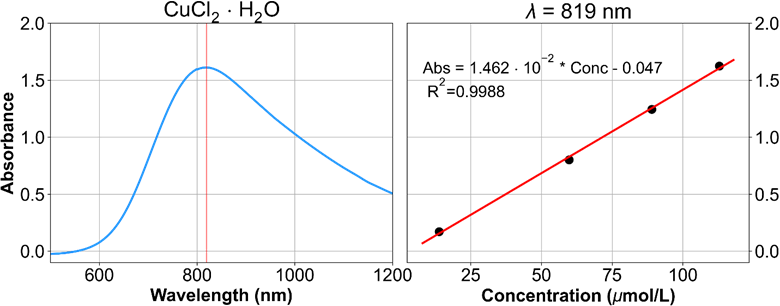
Absorbance spectra can be used to determine the chemical concentration of a molecule in solution. The absorbance at a particular wavelength of standards with various concentrations are used to build a calibration curve. The concentration of the chromophore in an unknown solution can then be determined.

Absorbance spectrum (left) and calibration curve (right).

Polarization- and Angle-Resolved Reflectance

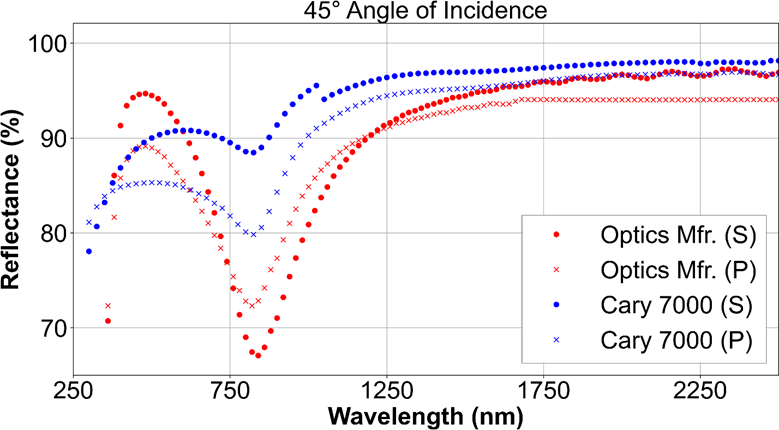
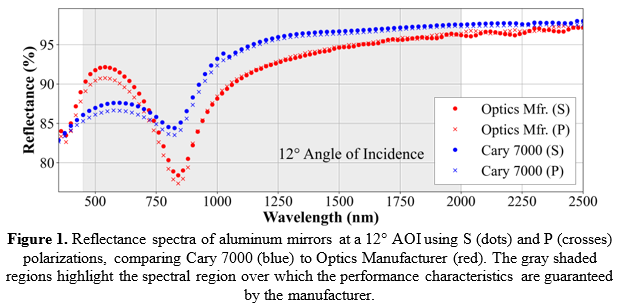
The specular reflection of a material is useful to know in industries such as optics manufacturing QA/QC and visual displays. Using the UMA, the polarization- and angle-resolved reflectance of a material can be determined. After initial sample loading into the UMA, robotics and automation take care of the rest.

Reflectance data taken by the Cary 7000 UMA (blue) and by the optics manufacturer (red).

Angle-Resolved %R and %T of a Dielectric Filter

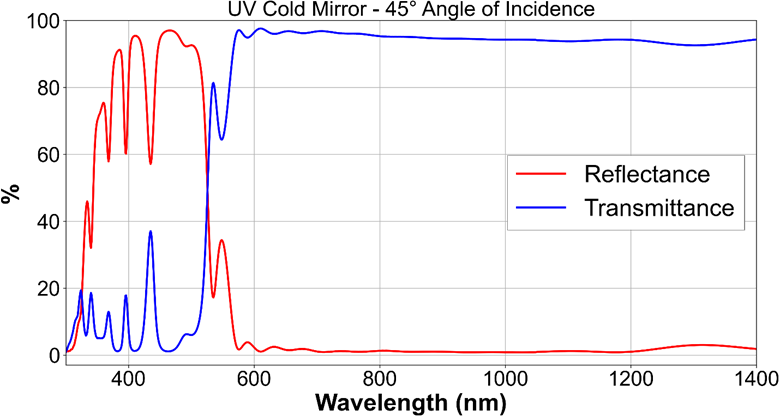
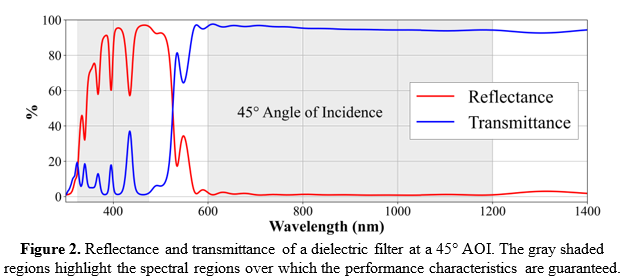
The UMA is capable of measuring %R and %T for a single Angle of Incidence (AOI) without having to touch the sample. Below the broadband reflectance and transmittance spectra of a dielectric filter are shown.

Reflectance (red) and transmittance (blue) spectra.

Diffuse Transmittance Using DRA

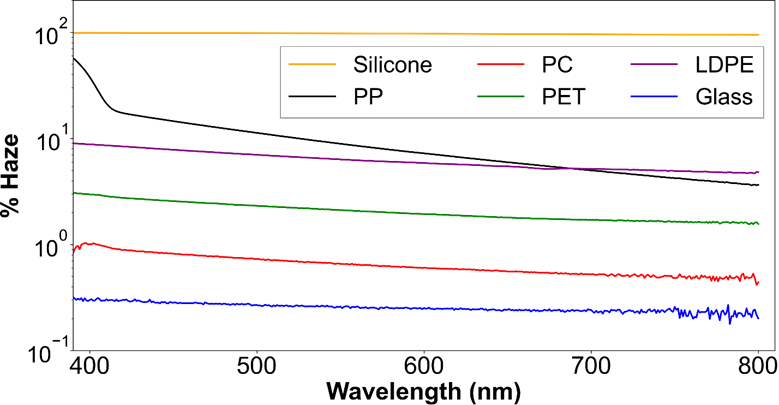
The inside of the integrating sphere of the DRA is completely covered with a high-reflectance PTFE coating that allows it to collect diffusely scattered light in reflection, transmission, and transflection geometries. The inclusion of a beam trap port allows for the specularly reflected or transmitted light to be included in the measurement, where material properties such as percent haze can be calculated.

Percent haze across the visible spectrum for five common plastics compared to glass.


Anti-reflection coatingsAbsolute reflectance/transmittance/absorptanceFilter cut-off/cut-on wavelength
Chemical concentrationDiffuse reflectance/transmittance/transflectanceExtinction coefficient
Molar absorption coefficientThin film thicknessGass quality
Optical ClarityLiquid & solid refractive indexSolar absorptance, reflectance, and transmittance
Laser safety eyewear

Instrument: Agilent Cary 7000 Universal Measurement Spectrophotometer

Instrument Key Specifications

Cary 7000 Base Spectrophotometer

SourceDeuterium Arc (UV), Tungsten Halogen (Vis), Mercury Lamp (NIR)
Spectral Range175-3300 nm
Resolution<0.048 nm (UV-Vis), <0.2 nm (NIR)
Spectral Bandwidth0.01-5.00 nm (UV-Vis), 0.04-20 nm (NIR)

UMA

Auto PolarizerS and P; variable from 0-90°
Sample PositionVariable from 0-360°
Spectral Range190-2800 nm
Detector Position10-350° at 0.02° intervals

DRA

Spectral Range200-2500 nm
Sphere Diameter150 mm
CoatingPTFE


ASTM Standards

ASTMTitleWebsite Link
E903Standard Test Method for Solar Absorptance, Reflectance, and Transmittance of Materials Using Integrating SpheresLink
D1003Standard Test Method for Haze and Luminous Transmittance of Transparent PlasticsLink
E1331Standard Test Method for Reflectance Factor and Color by Spectrophotometry Using Hemispherical GeometryLink
D1764Standard Test Method for Transparency of Plastic SheetingLink

ISO Standards

ISOTitleWebsite Link
13837Road vehicles — Safety glazing materials — Method for the determination of solar transmittanceLink
15368Optics and photonics — Measurement of reflectance of plane surfaces and transmittance of plane parallel elementsLink