Vickers and Micro Vickers hardness measurements through microindentation tests
(Hardness Testing, Knoop Hardness, Vickers Hardness)


Typical Experimental Results

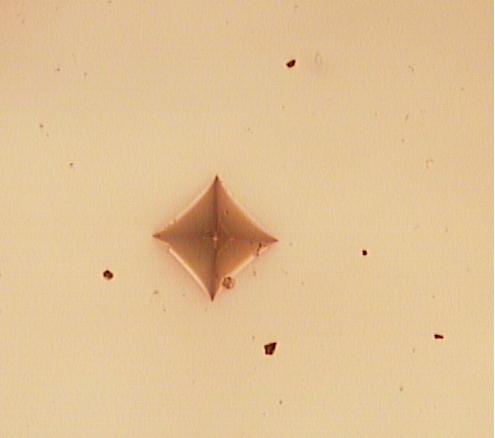
Vickers microindent on sample surface

Vickers indent made on a polycarbonate plate

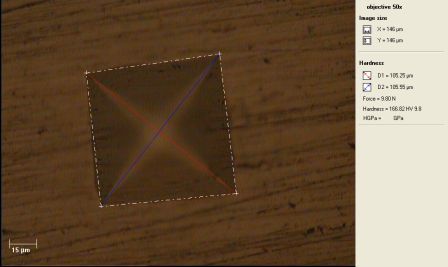
Vickers microindent with measurements

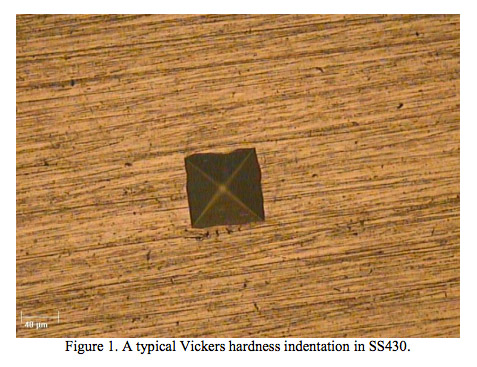
Vickers indent for hardness measurement of stainless steel plate

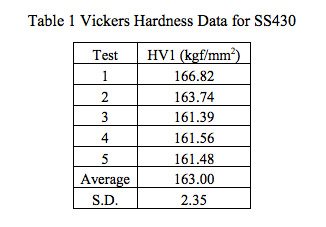
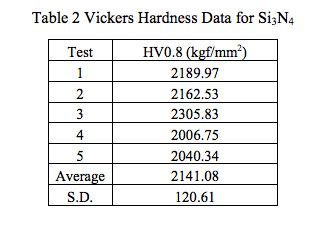
Vickers Hardness Measurement Results, HV1 (kgf/mm2)

TestSS430BrassSi3N4
1166.82217.832189.97
2163.74221.462162.53
3161.39225.202305.83
4161.56205.202006.75
5161.48217.652040.34
Average163.00217.472141.08
Standard Deviation2.356.73120.61

Applications

 Ceramics Coatings Composite Materials
 Decorative Coatings Hardness Knoop Hardness
 Metals Micro Hardness Micro Vickers Hardness
 Minerals Steel, Cast Iron, Alloys Surface Modification Layers
 Surface Treatment Super Facial Hardness Thermal Barrier Coatings
 Thin Films Vickers Hardness Wear Resistant Coatings

Instrument: The Micro-Combi Indentation and Scratch Tester

The Micro-Combi Indentation and Scratch Tester in laboratory with scientist
Microindentation for hardness testing on mounted puck

Instrument Key Specifications

Max Loadup to 30 N
Load Resolution0.3 mN
Max Depth1 mm
Depth Resolution0.3 nm
Max Scratch Length120 mm
Scratch Speed0.4-600 mm/min


Vickers Hardness Testing of Metallic and Ceramic Materials

The Vickers hardness test was developed in 1924 as a method for determining a material’s hardness regardless of an indenter’s size. It can be used for most materials, irrespective of hardness, and has one of the widest scales among hardness tests. The test is governed by ASTM standard E384 for loads ranging from 1 gf to 120 kgf. A typical Vickers hardness indentation can be seen in Figure 1.

Vickers indent for hardness testing with ASTM E384

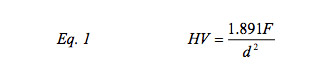
The Vickers hardness test is performed by pressing a diamond indenter tip in the form of a square-based pyramid into the sample at a specific load and then measuring the diagonal distances of the square indent that is created. The Vickers Hardness value, HV, is obtained via Equation 1,

Vickers hardness formula

where F is the indenting force in kgf and d is the average diagonal distance of the indentation in millimeters. The standard notation for reporting is HV followed by a number representing the indentation load in kgf. For example, 20 HV8 indicates a Vickers hardness value of 20 kgf/mm2 under a load of 8 kgf. Different indentation loads are selected depending on the thickness and volume of the sample that will be indented on.

Vickers hardness testing is typically performed on samples that are too small or too thin to allow for testing using a different method. Stainless steel alloy 430 is frequently used as a thin protective liner for equipment used in moderately corrosive environments such as dishwashers, chemical processing equipment, heat exchangers, etc. As such, Vickers hardness testing is an appropriate method for testing SS430’s mechanical properties in many applications. Vickers hardness data for fully annealed SS430 obtained using a CSM Micro Indentation and Scratch Combi Tester (CSM Instruments, Switzerland) is given in Table 1.

Vickers hardness test data on stainless steel alloy

Vickers hardness testing is also frequently used to characterize ceramic materials. Silicon nitride, Si3N4, is an engineering ceramic that is prized for its hardness, low coefficient of thermal expansion, superior wear resistance and corrosion resistance. Since there are several different methods of processing Si3N4, a Vickers hardness test can yield valuable information regarding how the material was processed and its resulting properties. Vickers hardness data for Si3N4 obtained using a CSM Micro Indentation and Scratch Combi Tester is given in Table 2.

Vickers hardness test data on Silicon nitride (Si3N4)

ASTM Standards

ASTMTitleWebsite Link
E384Standard Test Method for Knoop and Vickers Hardness of MaterialsLink
B933Standard Test Method for Microindentation Hardness of Powder Metallurgy (PM) MaterialsLink
F2328Standard Test Method for Determining Decarburization and Carburization in Hardened and Tempered Threaded Steel Bolts, Screws, Studs, and NutsLink
C1327Standard Test Method for Vickers Indentation Hardness of Advanced CeramicsLink
E1077Standard Test Methods for Estimating the Depth of Decarburization of Steel SpecimensLink

ISO Standards

ISOTitleWebsite Link
22826Destructive tests on welds in metallic materials– Hardness testing of narrow joints welded by laser and electron beam (Vickers and Knoop hardness tests)Link
6507-2Metallic materials– Vickers hardness testLink
14705Fine ceramics (advanced ceramics, advanced technical ceramics)– Test method for hardness of monolithic ceramics at room temperatureLink
14271Resistance welding– Vickers hardness testing (low-force and microhardness) of resistance spot, projection, and seam weldsLink
4498Sintered metal materials, excluding hardmetals– Determination of apparent hardness and microhardnessLink
3878Hardmetals– Vickers hardness testLink
9015-2Destructive tests on welds in metallic materials– Hardness testingLink
14577-1Metallic materials– Instrumented indentation test for hardness and materials parametersLink