Scratch resistance, mar resistance, interfacial adhesion measurements through microscratch tests.
(Scratch Testing and Coating Interfacial Adhesion Evaluation)


Typical Experimental Results

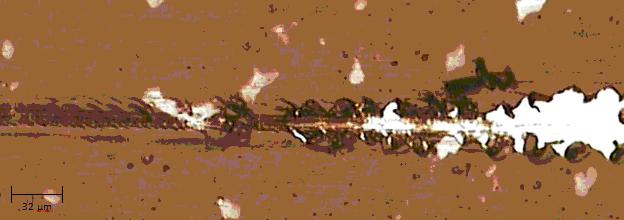
Microscratch optical image of paint coating

Optical micrograph of a scratch made on paint coating of a Pepsi can

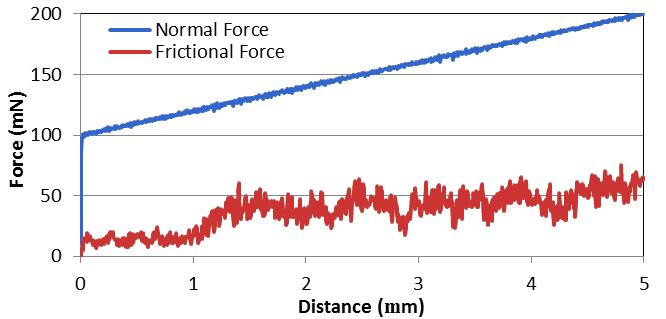
Test data from microscratch testing on paint coating

Test data for the scratch made on paint coating of a Pepsi can


Applications

Biological SamplesCoating AdhesionCoating Cohesion
Coating HardnessCoating Interfacial AdhesionFriction Coefficient
Hard CoatingsMar ResistanceMetallization Layer
Micro ScratchOptical ComponentsPaint
Passivation LayersPharmacological SamplesProtective Coatings
Scratch ResistanceSelf-Lubricating SystemsSliding Bearing
Soft CoatingsWear Resistance 


Instrument: The Micro-Combi Indentation and Scratch Tester

The Micro-Combi Indentation and Scratch Tester in laboratory

Instrument Key Specifications

Max Loadup to 30 N
Load Resolution0.3 mN
Max Depth1 mm
Depth Resolution0.3 nm
Max Scratch Length120 mm
Scratch Speed0.4-600 mm/min

Interfacial Adhesion Evaluation of Paint Coatings on a Pepsi Can through Scratch Testing

Surface coatings are frequently used to improve the surface properties of the material that they are applied to, also known as the substrate. Such surface property improvements include corrosion resistance, oxidation resistance, thermal barrier, wettability, aesthetics, wear resistance, and scratch resistance. Performing a scratch test on a surface coating can help characterize the mar and scratch resistance, interfacial adhesion strength, and coefficient of friction of such coatings.

One of the most commonly used surface coatings is paint, a two-phase composite material consisting of pigment particles and other additives dispersed in a continuous polymer matrix that adheres to the substrate, protecting it from the surrounding environment. Paint is used in the soft drink industry to increase the aesthetic appeal of the aluminum cans used to store the beverages. It needs to have good cohesive and adhesive strength, as excess scratching or wear during transportation will diminish the aesthetic appeal provided by the paint coating before it reaches its consumer.

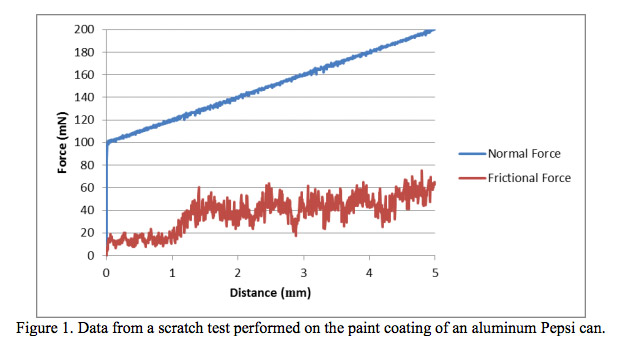
Test data from microscratch testing on paint coating

Scratch testing has been widely accepted and used as a way of evaluating interfacial adhesion of coatings/substrate systems. Failure events may be found where the scratch probe produces delamination, debonding, crack, fracture, or breakthrough at the coating/substrate interface. The failure events of the coatings are normally symbolized by a combination of sudden changes in the lateral force, normal displacement, and/or normal force data. The critical load of coating interfacial failure is defined as the normal force applied to the scratch probe at the time when interfacial failure is detected. The critical load of coating adhesion failure is a good indication of interfacial adhesion strength. Normally, a higher critical load represents a higher interfacial adhesion. There are a few other ways to help identify critical loads when performing scratch tests. The most common technique involves monitoring acoustic emission from the sample during scratch, which works very well for hard and brittle coatings. Other techniques involve recording and monitoring coefficient of friction, or examining the scratch path with optical microscopy.

Scratch test data for the paint coatings on an aluminum Pepsi can is shown in Figure 1. This data was obtained on Ebatco NAT Lab’s Micro Indentation and Scratch Combi Tester (CSM Instruments, Switzerland).

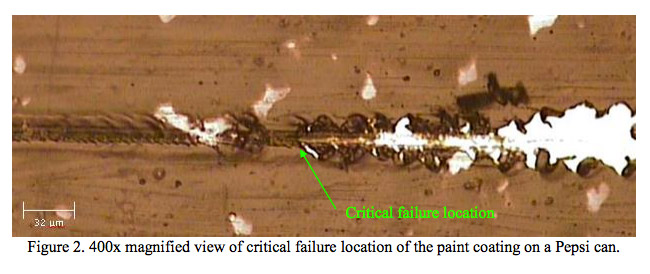
From Figure 1, it can be seen that there is a large change in frictional force around the 1 mm displacement mark. Figure 2 shows the corresponding location of the scratch as viewed from an optical microscope. The failure location corresponds to a critical load of coating interfacial adhesion failure at 118.88 mN.

Critical failure location labeled on optical image of paint coating
Scratch Failure Characteristics of DLC Coating on M2 Steel

Diamond-Like Carbon (DLC) coatings are frequently used on parts in high performance applications to prevent surface damage or reduce friction of moving parts. DLC coatings can be applied to almost any material that is compatible with vacuum environments and have many applications including electronics, automobiles, tools, shaving razors, and biomedical implants. The hardness and strength of the coating can vary greatly depending on how it is deposited and its intended applications. Due to this high variability, characterizing the properties of such coatings can provide very useful information for the preparation process optimization as well as performance evaluation.

One method for characterizing the properties of DLC coatings is scratch testing. In this method, a diamond stylus that is subjected to an increasing normal force is drawn across the coating surface. At some point, the coating will fail due to increased normal and tangential stresses applied by the moving diamond stylus. The normal forces applied to the scratching stylus at the points that a coating fails are called the critical loads of failure.

Critical failure points on scratch tests

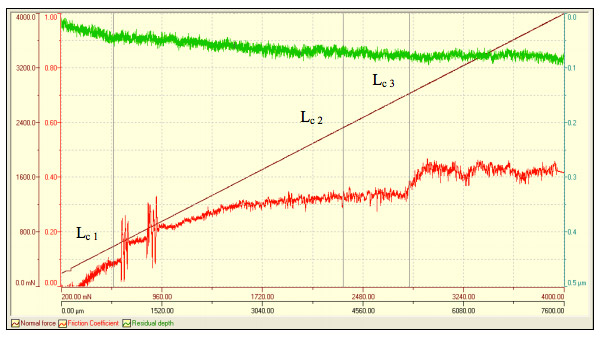
Figure 1. Scratch test data for a DLC coating on M2 steel; the vertical grey lines mark the critical failure points and the corresponding normal forces are critical loads: Lc 1, Lc 2 and Lc 3.

A DLC-coated bar of M2 steel was tested in Ebatco’s Nano Analytical Test Lab using a MicroScratch Tester made by CSM Instruments (Switzerland). The scratch data is presented in Figure 1. There are several ways to identify critical loads when performing scratch tests. The most common techniques involve monitoring acoustic emission from the sample, looking for changes in coefficient of friction and scratch normal displacement, or post facto observation via reflected light microscopy on the scratch track.

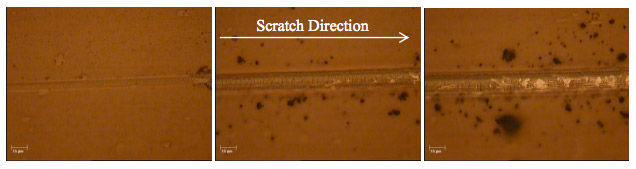
As can be seen in Figures 1 and 2, the DLC coating exhibited distinctive scratch failure characteristics along the scratch. Three critical loads at 0.59N, 2.33N and 2.83 N corresponding to onsets of adhesive cracking, adhesive spallation and gross adhesive spallation were determined from the scratch data and optical microscopic images. The changes in coefficient of friction and normal displacement in the test data correlate well with the optical observations at the three critical points of coating failure.

Scratch track from scratch testing showing failure critical loads of DLC coating

Figure 2. Optical micrographs of the scratch track showing the failure characteristics of the DLC coating on M2 steel; the centers of the scratch track images corresponding to Lc 1 (left image, cohesive cracking), Lc 2 (center image, adhesive spallation), Lc 3 (right image, gross adhesive spallation).


ASTM Standards

ASTMTitleWebsite Link
G171Standard Test Method for Scratch Hardness of Materials Using a Diamond StylusLink
F2496Standard Practice for Determining the Scratch Hardness and Scrape Adhesion of Prints and CoatingsLink
D7027Standard Test Method for Evaluation of Scratch Resistance of Polymeric Coatings and Plastics Using an Instrumented Scratch MachineLink
C1624Standard Test Method for Adhesion Strength and Mechanical Failure Modes of Ceramic Coatings by Quantitative Single Point Scratch TestingLink

ISO Standards

ISOTitleWebsite Link
18922Imaging materials– Processed photographic films– Methods for determining scratch resistanceLink
19252Plastics– Determination of scratch propertiesLink
1518-1Paints and varnishes– Determination of scratch resistanceLink
27307Thermal spraying– Evaluation of adhesion/cohesion of thermal sprayed ceramic coatings by transverse scratch testingLink
15695Vitreous and porcelain enamils– Determination of scratch resistance of enamel finishesLink
20502Fine ceramics (advanced ceramics, advanced technical ceramics)– Determination of adhesion of ceramic coatings by scratch testingLink