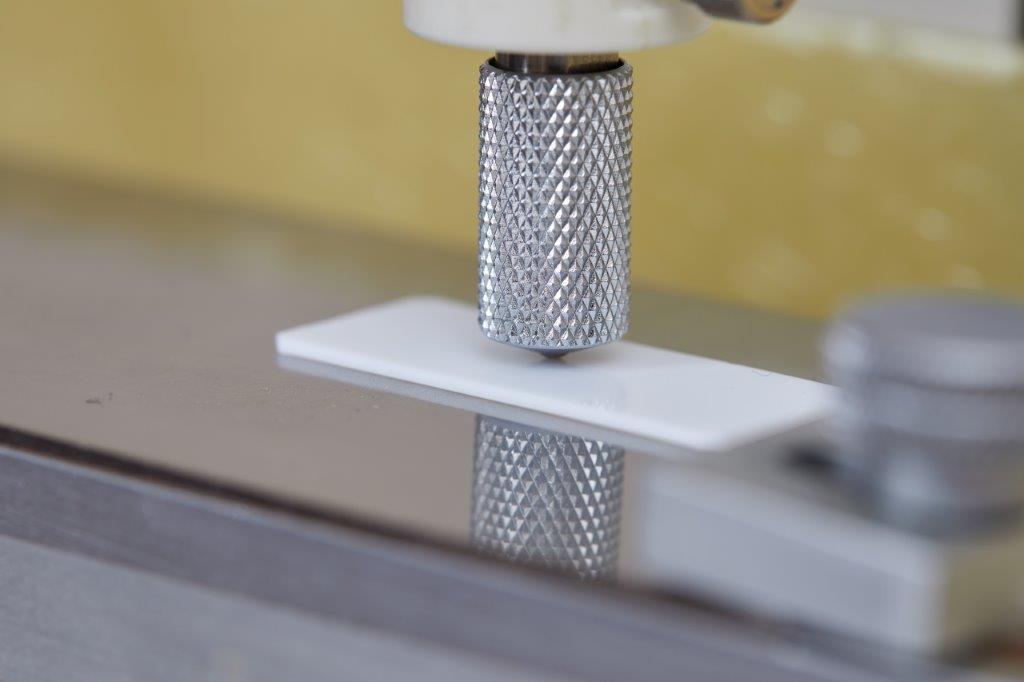
Friction is a key component for real world applications. Any material that makes contact with another surface will have a friction force. Two key components of friction are the static and kinetic friction coefficients. A single pass over a sample surface with a specified contact part and a known load can measure these friction coefficients.


Typical Experimental Results

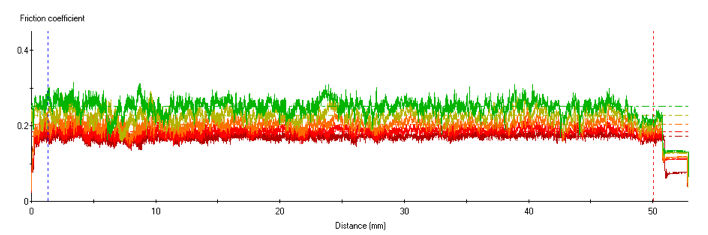
Table 1 Friction Coefficient Results for Steel Plate against a Steel Ball

Testµsµkµkmaxµkminµkw
10.1890.1720.1830.1580.025
20.2070.1830.1980.1670.031
30.2360.2040.2230.1840.039
40.2570.2280.2520.2030.049
50.3070.2510.2780.2210.057
Average0.2390.2080.2270.1870.04
S.D.0.0460.0320.0390.0260.013
Friction Coefficient for Steel Plate against Steel Ball

Figure 3. Friction coefficient as a function of distance for a steel plate against a steel ball.

Friction Coefficient Results for Acuvue Oasys and Acuve TruEye Contact Lenses against a Glass Slide

Contact Lensµsµkµkmaxµkminµkw
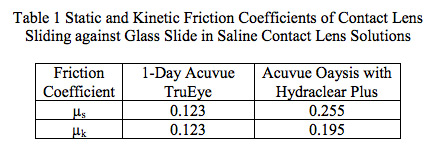
Oaysis0.2550.1970.2130.1810.032
TruEye0.1230.1230.1380.1040.034
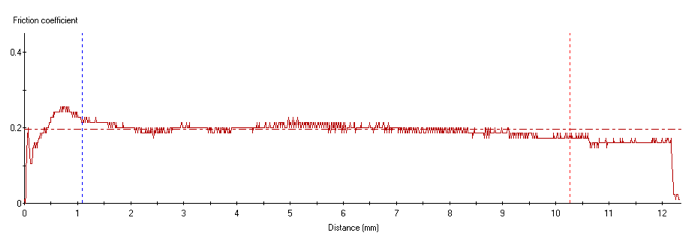
Friction Coefficient for Contacts Lens against Glass Slide 1

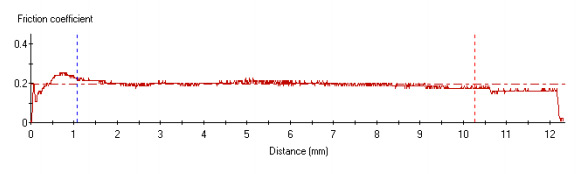
Friction coefficient as a function of sliding distance for Acuvue Oasys with Hydraclear Plus contact lens against glass slide in saline contact lens solution.

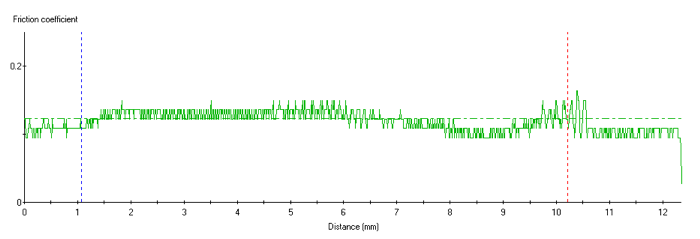
Friction Coefficient for Contact Lens against Glass Slide 2

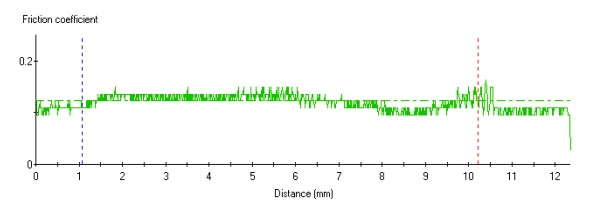
Friction coefficient as a function of sliding distance for the 1 Day Acuvue TruEye contact lens against glass slide in saline contact lens solution.


Applications

Automated Stage MovementCeramicsCoatings and Films
Contact LensesFabricsKinetic Friction
MetalsPaperPeeling
PID Temperature ControlPlasticsPrinted Surfaces
Printer RollersReciprocating MotionRepeat Measurements
Rubbing and Wear TestingStatic FrictionSurface Condition
Variable CyclesVariable LoadVariable Speed
Various Contact TypesWear ResistanceWet and Dry Friction

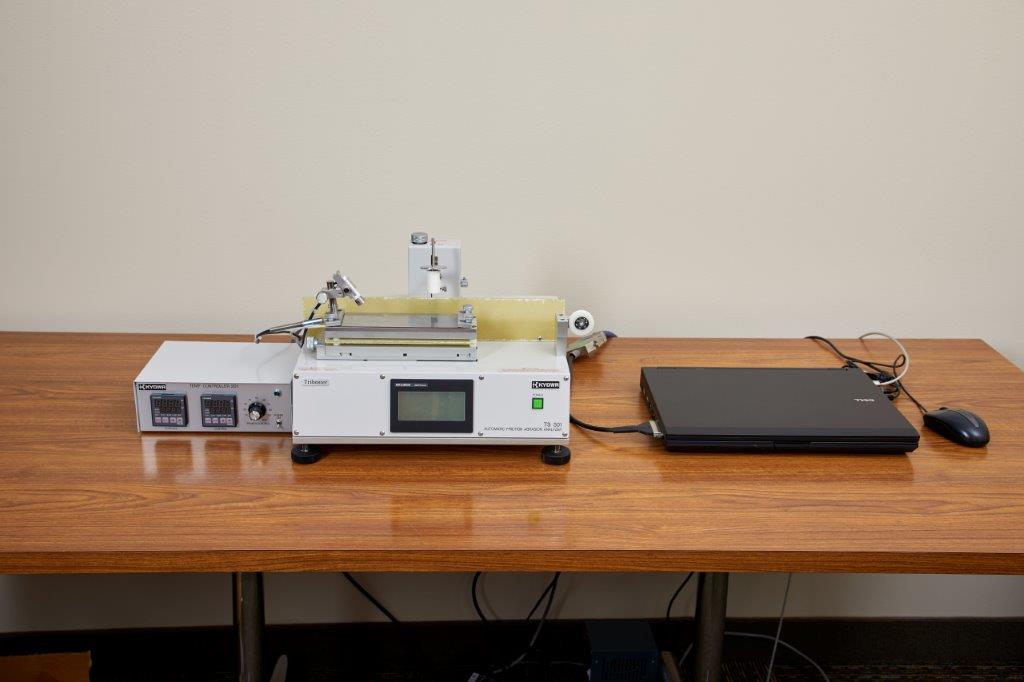
Instrument: Kyowa TS-501 Triboster

Kyowa-501 Triboster
Balance Head on Kyowa TS-501 Triboster Stage

Instrument Key Specifications

Detecting Range0-500gf (4.9N) Friction Force
Friction Coefficient Resolution0.001
Maximum Sample Size178x60x50mm
Measurement Speed0.2-100mm/s
Maximum Repetitions1000
Measurement Stroke1-80mm
Maximum Temperature200°C

Friction


Friction of Contact Lenses in Saline Solution

Friction is a measure of a surface’s resistance to motion. When two surfaces are rubbing against each other, friction acts as the force to prevent the two surfaces from moving in a given direction. Continued relative motion leads to material loss or wear of the surface and its friction counterpart. Over time, a surface will degrade to a point that renders the surface unusable for its designed application. Altering the surface chemistry can change the friction properties to better suit the application needs and help to prolong the material’s useful life.

Friction of Contact Lenses in Saline Solution AppNote-37

Figure 1. Friction coefficient as a function of sliding distance for the 1-Day Acuvue TruEye contact lens against glass slide in saline contact lens solution.

Friction of Contact Lenses in Saline Solution AppNote-38

Figure 2. Friction coefficient as a function of sliding distance for the Acuvue Oaysis with Hydraclear Plus contact lens against glass slide in saline contact lens solution.

The TS-501 Triboster, manufactured by Kyowa Interface Science Co., Ltd., is capable of measuring both the static and kinetic friction coefficients of a material surface in a single pass or multiple passes under dry or lubricated conditions with temperature control from room temperature to 180ºC. The high sensitivity friction transducer and low loads employed by the TS-501 allow for softer materials like polymers, fabrics and thin films to be tested with ease and accuracy. The velocity of the stage is automatically controlled by user input values from 0.02mm/s to 100mm/s.

Friction of Contact Lenses in Saline Solution AppNote-39

Most of the disposable contact lenses are made of extremely soft hydrogels with significant amount of water content. Wearing contact lenses is becoming trendy for people whether it is for cosmetic, corrective or therapeutic reasons. In addition to many designed functionalities of the contact lenses wearing comfort is a key factor to be well controlled by the contact lens designer. One of the aspects of the wearing comfort is the friction between eyelid and the contact lens.

As shown in Figures 1 and 2, and Table 1, two different kinds of commercially available contact lenses from Johnson & Johnson Vision Care, Inc. were tested for friction using the TS-501. The first kind of contact lens tested was 1-Day Acuvue TruEye disposable contact lens. The second kind of contact lens was Acuvue Oaysis Hydraclear Plus disposable contact lens. Both kinds of contact lenses were tested under the same conditions and parameters sliding against glass slide in saline contact lens solution. From the results it is obvious that the static and kinetic friction coefficients for the two kinds of contact lenses are different. The different friction coefficients would result in different wearing comfort for people.


ASTM Standards

ASTMTitleWebsite Link
G115Standard Guide for Measuring and Reporting Friction CoefficientsLink
G163Standard Guide for Digital Data Acquisition in Wear and Friction MeasurementsLink
D4103Standard Practice for Preparation of Substrate Surfaces for Coefficient of Friction TestingLink
D2534Standard Test Method for Coefficient of Kinetic Friction for Wax CoatingsLink
G203Standard Guide for Determining Friction Energy Dissipation in Reciprocating TribosystemsLink
D1894Standard Test Method for Static and Kinetic Coefficients of Friction of Plastic Film and SheetingLink

ISO Standards

ISOTitleWebsite Link
8295Plastics– Film and sheeting– Determination of the coefficients of frictionLink
20808Fine ceramics (advanced ceramics, advanced technical ceramics)– Determination of friction and wear characteristics of monolithic ceramics by ball-on-disc methodLink
15113Rubber– Determination of frictional propertiesLink
15359Paper and board– Determination of the static and kinetic coefficients of friction– Horizontal plane methodLink