DMA is a highly sensitive method for measuring how various physical properties, such as storage and loss modulus, change with temperature. Using a DMA, it is possible to perform tensile, compression, shear, 3-point bend, dual and single cantilever type tests. Even thin films and fibers can be tested.


Typical Experimental Results

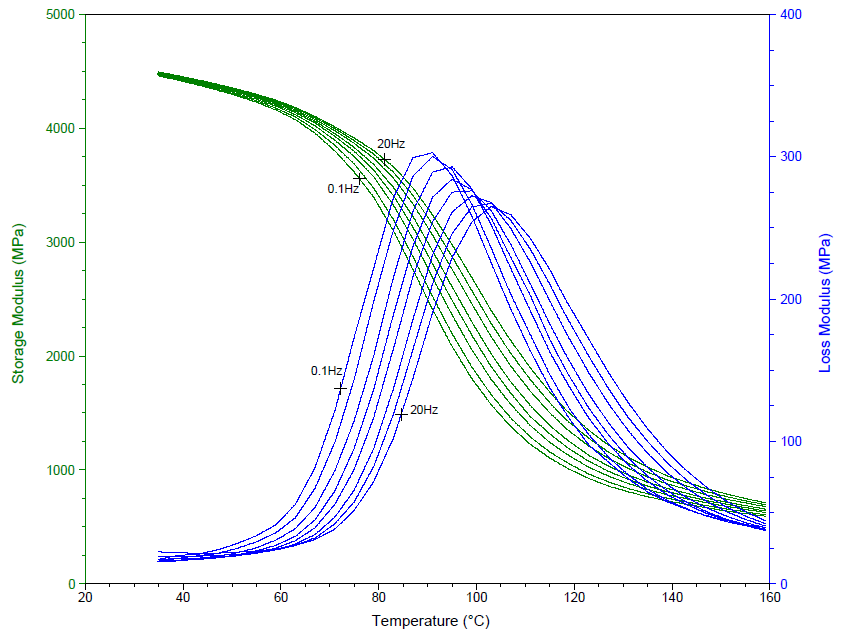
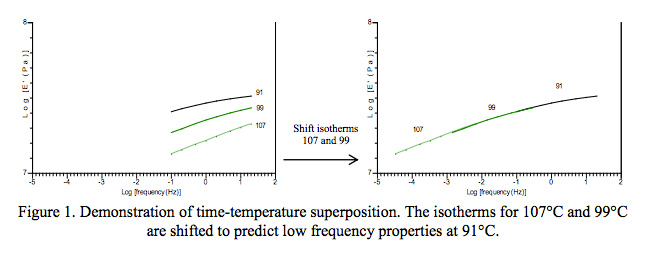
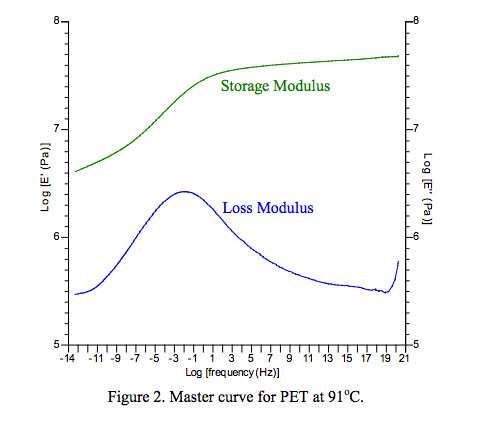
DMA measurements for Storage Modulus for time temperature superposition of PET Tape

Time-Temperature Superposition Testing of PET Tape

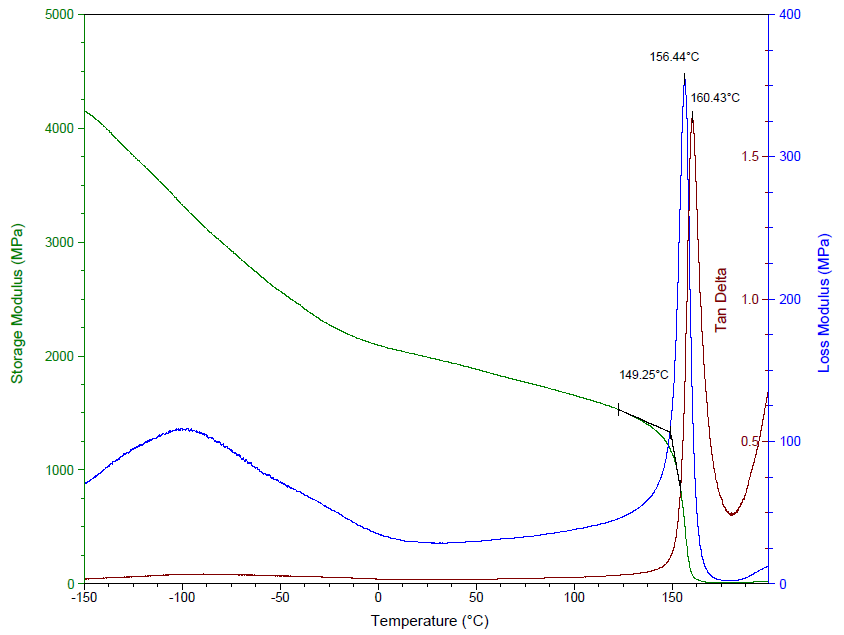
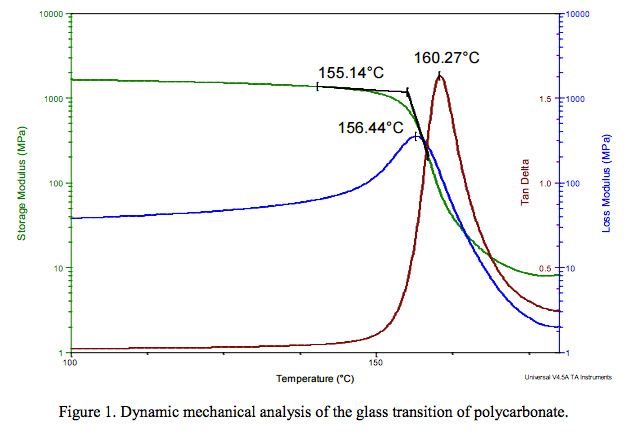
1 Hz Frequency DMA test on polycarbonate

1 Hz Frequency Test on Polycarbonate


Applications

3-Point BendComplex ModulusComplex/Dynamic Viscosity
CompressionControlled Force/Strain RateCreep Compliance
Equilibrium Recoverable ComplianceFilm AnalysisFrequency Effect
Glass TransitionIsostrainLoss Modulus
Multi-FrequencyMulti-Stress/StrainRelaxation Modulus
Sample StiffnessSecondary TransitionsShear Sandwich
Static/Dynamic ForceStorage ModulusStorage/Loss Compliance
Stress RelaxationStress/Strain BehaviorSubmersible Clamps
Tan DeltaTensionViscoelastic Characterization

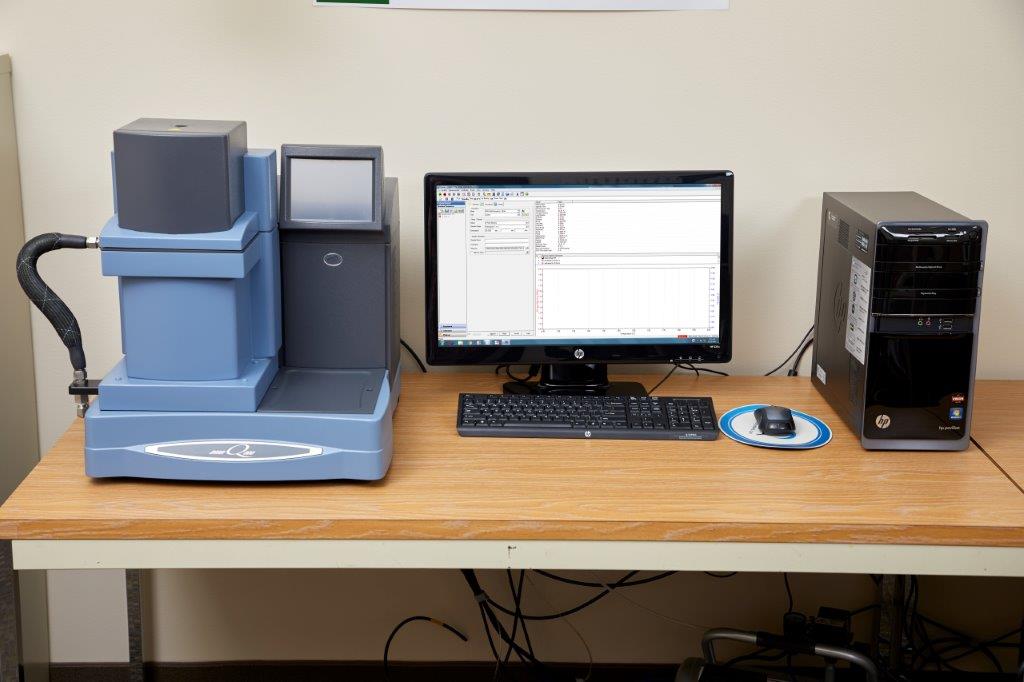
Instrument: TA Instruments Q800 Dynamic Mechanical Analyzer

TA Instruments Q800 Dynamic Mechanical Analyzer in laboratory
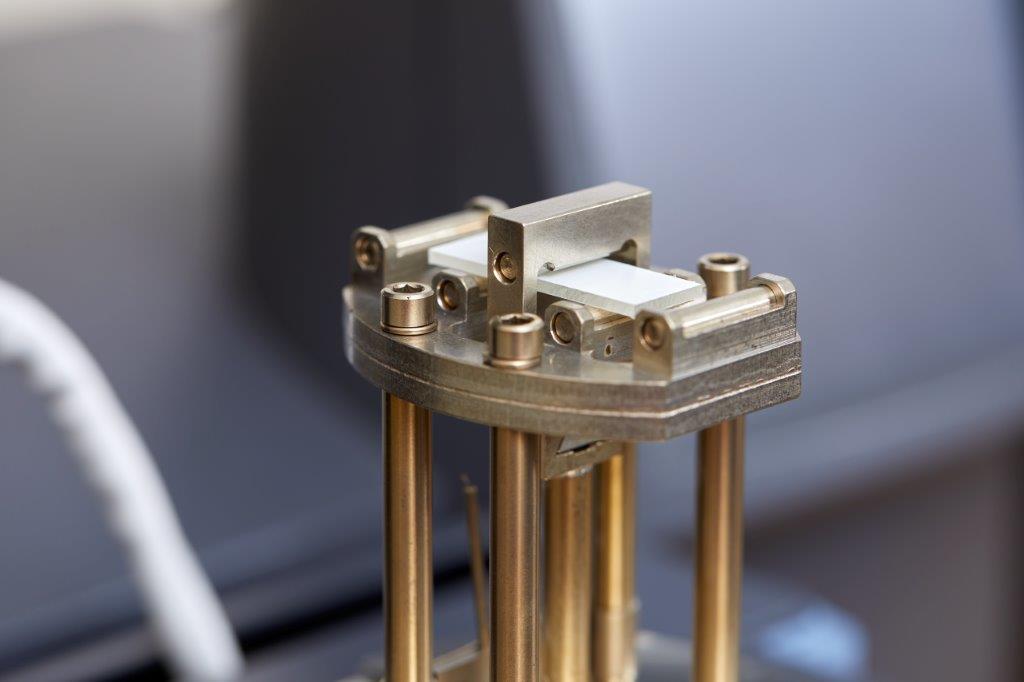
3 point bend fixture for DMA measurements

Instrument Key Specifications

Temperature Range-150 to 600°C
Isothermal Stability± 0.1°C
Modulus Precision± 1%
Tan δ Resolution0.00001
Strain Resolution1 nm
Force Range0.0001 to 18 N
Force Resolution0.00001 N
Frequency Range0.01 to 200 Hz
AtmosphereInert, Oxidizing, or Reactive Gases

Glass Transition Determination by DMA


Glass Transition Temperature Measurements Using Dynamic Mechanical Analysis

In addition to first-order phase transitions such as melting and vaporization, there are secondorder transitions that occur in certain materials. One of these second-order transitions is the glass transition exhibited by amorphous materials. When amorphous materials are cooled below their glass transition temperatures, they become hard and brittle, like glass; when the amorphous materials are heated above their glass transition temperatures, they are in the rubbery state, where they are soft and flexible. This glass transition phenomenon is mainly because the molecular chains become entangled and cannot slip pass each other at low temperatures. The temperature at which the molecular chains become ‘locked’ upon cooling or ‘released’ upon heating is referred to as the glass transition temperature (Tg).

However, the glass transition does not occur at a single temperature. Depending on the definition in use and method to measure, it can be defined as the temperature at which the material (a) suddenly loses mechanical strength, (b) exhibits a step-change in specific heat capacity, or (c) exhibits increased thermal expansion. There are even more definitions depending on which properties are important for the end use.

Glass transition temperature, storage modulus, and loss modulus of polycarbonate

In this application study, the glass transition temperature of polycarbonate was determined using a Q800 Dynamic Mechanical Analyzer (DMA) manufactured by TA Instruments. This test system characterizes the viscoelastic behavior of materials by applying a sinusoidal force to a specimen and measuring the material response. For viscoelastic materials, the responses are time-dependent and vary depending upon the frequency and temperature at which the force is applied. By loading the specimen in tension, compression, bending, or shear, the DMA is able to determine storage and loss moduli and damping properties of a material for a specific temperature and frequency. This gives the system unparalleled sensitivity in characterizing the thermo and dynamic mechanical properties of materials.

With DMA, a material’s transition from the glassy to the rubbery state is signaled by a dramatic decrease in storage modulus, a peak in loss modulus and a peak in damping coefficient (tan delta), all occurring immediately one after another. Each of these events occurs at a slightly different temperature but combine to describe the temperature range over which the glass transition occurs. The sudden decrease in storage modulus occurs at the lowest temperature and indicates physical softening. If the material is heated above this temperature in mechanical service, it will fail. The peak in loss modulus occurs at the middle temperature and indicates segmental motion within the material. The peak in tan delta occurs at the highest temperature and indicates the midpoint of the material’s transition between the glassy and rubbery states. This is illustrated in Figure 1 using the results obtained on polycarbonate.

The polycarbonate was tested using a load frequency of 1 Hz. Due to polymer’s time-dependent properties, a change in test frequency will alter the measured Tg. Ebatco’s Application Note on the principle of time-temperature superposition discusses this phenomenon in more depth.

Time-Temperature Superposition Using Dynamic Mechanical Analysis

With their low cost and ease of manufacture, structural polymer components have become increasingly common in consumer products. While switching from metal to polymeric components can decrease the material cost of a product, there are additional design considerations to take into account. One of those considerations is the viscoelastic nature of polymeric materials.

The time and temperature dependent behavior of polymers is due to their molecular structures. As a polymer is stressed, it undergoes molecular rearrangement in an attempt to relieve the stress. This results in an apparent decrease in stiffness (or storage modulus) over time. This would seem to imply that polymers must be evaluated for specific applications by testing under the conditions they will be subjected during use. Fortunately, there is a demonstrated relationship between the time (frequency) and temperature at which a material is tested. In other words, it is possible to determine very low (or high) frequency properties by simply testing the material at a higher (or lower) temperature. This relation is known as ‘time-temperature superposition’ (TTS).

Dynamic mechanical analysis (DMA) characterizes the viscoelastic behavior of materials by applying a sinusoidal force to a specimen and measuring the material response. It is one of the most sensitive and accurate techniques for applying the time-temperature superposition principle.

Time temperature superposition (TTS) to determine a single isotherm

With TTS, it has been demonstrated that it is possible to determine material properties for very low or high frequencies by performing creep, stress relaxation, or multiple frequency tests at a variety of different temperatures. By shifting the isothermal data along the time (frequency) axis, it is possible to obtain a single isotherm, typically referred to as the ‘master curve,’ of the modulus for a much broader range of frequencies than was tested. This is illustrated in Figure 1. The amount of shifting required to obtain the master curve can be mathematically described by the Williams-Landel-Ferry equation, shown in Equation 1.

Williams-Landel-Ferry equation

In this equation, T0 is the reference temperature, i.e. the temperature to which all the isotherms are shifted. T0 is typically defined as the glass transition temperature, Tg. C1° and C2° are empirical constants (17.4 and 51.6, respectively, for many amorphous polymers), T is the temperature of the isotherm to be shifted, and aT is the shift factor.

To illustrate the principle of TTS, Ebatco’s NAT Lab tested poly(ethylene terapthalate) (PET) ribbon at a variety of temperatures and frequencies. By applying the WLF model, the isotherms are shifted to create a master curve for the storage (E’) and loss (E”) moduli at 91°C, the glass transition temperature of the material, presented in Figure 2.

Storage modulus and loss modulus of PET poly(ethylene terapthalate)

ASTM Standards

ASTMTitleWebsite Link
E1640Standard Test Method for Assignment of the Glass Transition Temperature By Dynamic Mechanical AnalysisLink
D6382Standard Practice for Dynamic Mechanical Analysis and Thermogravimetry of Roofing and Waterproofing Membrane MaterialLink
D7028Standard Test Method for Glass Transition Temperature (DMA Tg) of Polymer Matrix Composites by Dynamic Mechanical Analysis (DMA)Link
E2425Standard Test Method for Loss Modulus Conformance of Dynamic Mechanical AnalyzersLink
E2254Standard Test Method for Storage Modulus Calibration of Dynamic Mechanical AnalyzersLink
E1867Standard Test Method for Temperature Calibration of Dynamic Mechanical AnalyzersLink
D5279Standard Test Method for Plastics: Dynamic Mechanical Properties: In TorsionLink
D5026Standard Test Method for Plastics: Dynamic Mechanical Properties: In TensionLink
D5024Standard Test Method for Plastics: Dynamic Mechanical Properties: In CompressionLink
D4440Standard Test Method for Plastics: Dynamic Mechanical Properties Melt RheologyLink
D4473Standard Test Method for Plastics: Dynamic Mechanical Properties: Cure BehaviorLink
D5023Standard Test Method for Plastics: Dynamic Mechanical Properties: In Flexure (Three-Point Bending)Link

ISO Standards

ISOTitleWebsite Link
6721Plastics– Determination of dynamic mechanical propertiesLink