Ceramics and glasses are important in many industries as a part of constructing the desired product. The professional team at Ebatco can help determine if the glass or ceramic product has the material properties desired for the intended use. Our professional reports will provide accurate data to conclude if the glass or ceramic functions properly.

Ceramics and glasses are used in a variety of industries and it is important that the material can withstand the necessary environmental restrictions. For industrial manufacturing, it is important that glasses meet the required mechanical properties to increase integrity when exposed to environmental stresses, strain, and other physical entities. Glasses are used in many industries, such as construction, eyeglass, laboratory sciences, and many others. Ebatco can provide feedback that the product you are providing will be able to perform under given circumstances.

Ebatco has all of the material services you desire for development and verification of ceramics and glasses. Our expert scientists can quantify wear resistance, microstructure, fracture toughness, glass transition temperature and more. These tests can help assure that you develop the highest quality glasses and ceramics. If you have any questions about the services or instrumentation available at Ebatco, feel free to call or email and a member of our team will be able to further assist you.

Applications

Elemental distribution and mappingGlass transition temperatureFracture toughness and fractographyMicrostructureTensile, compression, and bending properties
Wear resistance evaluation    
In-situ and Small-Volume Fracture Toughness Measurement via Nanoindentation

For hardness testing via nano/micro indentation, any cracking caused by a sharp indenter tip and excessive load is undesirable and will lead to questionable data. However, such phenomenon and capability has been proven to be very useful in evaluating one of the critical mechanical properties of materials: fracture toughness. Fracture toughness is a measure of the materials ability to resist crack propagation and fracture under stress. Commonly used methods for evaluating fracture toughness of materials include bending, tension and impact tests of a specimen with a sharp crack or a defined notch. As regulated and recommended by many ASTM and international testing standards, these methods require the specimen with sufficient thickness and dimensions to ensure measurement validity. In many industrial and technical applications that involve small volume of materials, however, these requirements could not be practically met, for example in thin films, coatings, welds and miniaturized devices. The unmet needs by the conventional fracture toughness measurement methods have offered an excellent opportunity for the nanoindentation based techniques that are developed for mechanical characterization of small volume materials at nanoscale. Benefited from the established model and in-situ scanning probe microscopy (SPM) imaging capability, fracture toughness measurement via nanoindentation has become a preferred technique for in-situ and small-volume fracture behavior study of materials.

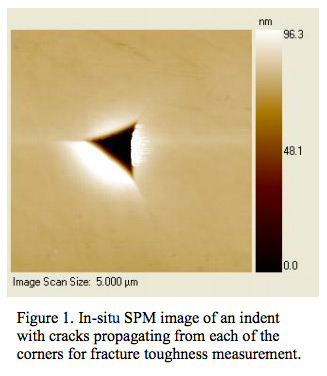
SPM image of indent with crack propagation

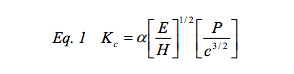
To measure fracture toughness of small volume of materials, a relative high load is chosen for a nanoindentation routine with the goal of creating cracks at the corners of the indent. Then the indented surface is imaged using the nanoindenter’s in-situ SPM imaging function to capture the fine features of corner cracks of the indent as shown in Figure 1. The fracture toughness of the material is calculated using the following equation:

Fracture toughness from crack propagation using Nanoindentation method

Where Kc is the indentation fracture toughness; E is elastic Young’s modulus, H is the hardness, P is the peak load and c is the average crack length from the center of the indent to the tips of the cracks. The constant, α, is a value related to the tip geometry and its values are known for cube cornered, Berkovich and Vickers tips.

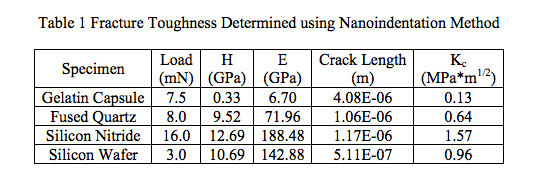
Very conveniently, the hardness values required for determining the fracture toughness can be easily measured by using a smaller load and performing the normal nanoindentation test without causing any cracks. The Young’s modulus is derived from the reduced elastic modulus determined through nanoindentation and the Poisson’s ratio of the material. The crack length is measured from the center of the indent for all formed cracks using imaging software. Table 1 presents indentation fracture toughness values of a few specimens made of different materials using the nanoindentation method.

Fracture toughness for gelatin, quartz, silicon nitride, and silicon wafer