The drive to have the most efficient materials for shipping and reduce material usage has driven the market for performance packaging and adhesives. With online markets increasing, companies are requiring a larger and more efficient industry for shipping of goods. Increasing demand of shipping requires an increase in the supply of engineered packaging and adhesives. It is vital to the integrity of the packaging that the mechanical properties of the materials are sufficient enough for the possible environments and stresses during the shipping process.

If the goal is to test the mechanical strength of packaging materials or characteristics of an adhesive, Ebatco has you covered. Ebatco has an array of instrumentation that can be used to test and verify the mechanical properties of packaging and adhesive materials. With our Peel Strength Analyzer, it is possible to precisely measure the force needed to remove an adhesive from a desired substrate. We can also test the characterization of ink on printed labels, the wettability of adhesives, the cause of high temperature adhesive failure, and more. Packaging materials can be tested for their mechanical properties so that it can be assured that your packaging will hold up during shipping and handling.

Our professional reports will allow you to know that all of the material properties of your package are sufficient for the environmental stress, reducing the tendency for shipping mishaps. If you have any questions about the services or instrumentation available at Ebatco, feel free to call or email and a member of our team will be able to further assist you.

Applications

Characterization of ink printed on labelsComparison of adhesive productsDetermination of packaging propertiesDetermination of the cause of high temperature adhesive failureProblem identification in adhesive composition
Mechanical strength of packaging materialPeel strength of pressure sensitive adhesivesWettability of adhesives  
Interfacial adhesion evaluation of paint coating on Pepsi Can through Scratch Testing

Surface coatings are frequently used to improve the surface properties of the material that they are applied to, also known as the substrate. Such surface property improvements include corrosion resistance, oxidation resistance, thermal barrier, wettability, aesthetics, wear resistance, and scratch resistance. Performing a scratch test on a surface coating can help characterize the mar and scratch resistance, interfacial adhesion strength, and coefficient of friction of such coatings.

One of the most commonly used surface coatings is paint, a two-phase composite material consisting of pigment particles and other additives dispersed in a continuous polymer matrix that adheres to the substrate, protecting it from the surrounding environment. Paint is used in the soft drink industry to increase the aesthetic appeal of the aluminum cans used to store the beverages. It needs to have good cohesive and adhesive strength, as excess scratching or wear during transportation will diminish the aesthetic appeal provided by the paint coating before it reaches its consumer.

Data from scratch test

Scratch testing has been widely accepted and used as a way of evaluating interfacial adhesion of coatings/substrate systems. Failure events may be found where the scratch probe produces delamination, debonding, crack, fracture, or breakthrough at the coating/substrate interface. The failure events of the coatings are normally symbolized by a combination of sudden changes in the lateral force, normal displacement, and/or normal force data. The critical load of coating interfacial failure is defined as the normal force applied to the scratch probe at the time when interfacial failure is detected. The critical load of coating adhesion failure is a good indication of interfacial adhesion strength. Normally, a higher critical load represents a higher interfacial adhesion. There are a few other ways to help identify critical loads when performing scratch tests. The most common technique involves monitoring acoustic emission from the sample during scratch, which works very well for hard and brittle coatings. Other techniques involve recording and monitoring coefficient of friction, or examining the scratch path with optical microscopy.

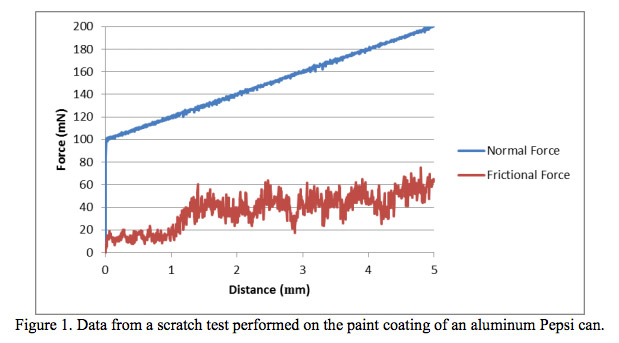
Scratch test data for the paint coatings on an aluminum Pepsi can is shown in Figure 1. This data was obtained on Ebatco NAT Lab’s Micro Indentation and Scratch Combi Tester (CSM Instruments, Switzerland).

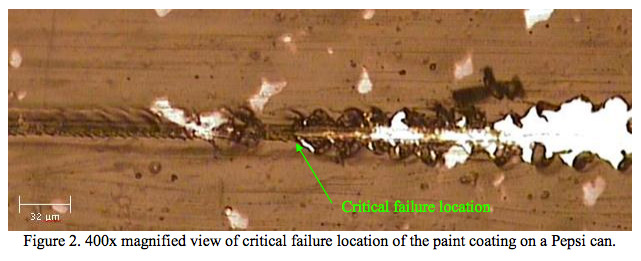
From Figure 1, it can be seen that there is a large change in frictional force around the 1 mm displacement mark. Figure 2 shows the corresponding location of the scratch as viewed from an optical microscope. The failure location corresponds to a critical load of coating interfacial adhesion failure at 118.88 mN.

Critical failure location of paint coating via scratch testing