Metals and alloys are some of the most widely used materials in manufacturing today due to their high strength, reliable properties, and processability. Metals and alloys are commonly used in construction, medical devices, small part manufacturing, and many other applications. Our NAT lab can perform alloy phase identification and element distribution analysis using scanning electron microscopy (SEM) and x-ray energy dispersive spectroscopy (EDS). We have an STA 449 F3 Jupiter Thermal Analyzer, which can perform differential scanning calorimetry (DSC) and thermogravimetric analysis (TGA) simultaneously. The Jupiter Thermal Analyzer can precisely measure the temperature of a phase transformation or decomposition up to 1650 °C.


Typical Experimental Results

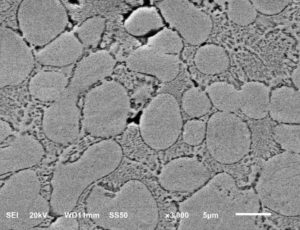
SEM image of Zinc-Aluminum alloy with la andmellar eutectic α phase and zinc-rich η phase.

SEM image of a Zinc-Aluminum alloy composed of a lamellar eutectic α phase (dendrite network) and a zinc-rich η phase.

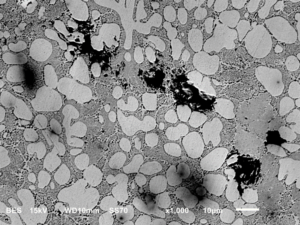
SEM Image of Zinc-Aluminum alloy

Backscatter electron image of a Zinc-Aluminum alloy. The brighter regions are the Zinc rich phase, the dull gray regions are the Aluminum rich phase, and the black regions are voids within the casting.

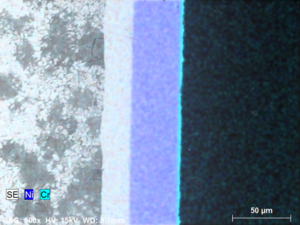
SEM/EDS image on Zinc-Aluminum alloy

SEM/EDS image of a cast Zinc-Aluminum part with Nickel and Chromium coatings.


Applications

AlloysCeramicsChemical EtchingCross-Section AnalysisCrystal Structures
Diffusion LayerElement DistributionElement IdentificationFailure AnalysisForeign Material Identification
Forensic AnalysisFractographyFracture StudyGrain BoundariesGrain Growth
Grain OrientationGrain SizeGrain StructureGrainsIC Failure Analysis
MaterialsMetallographyMetallurgyMetalsMicroscopy
MicrostructurePhase DiagramPhase DistributionSteelsWelds

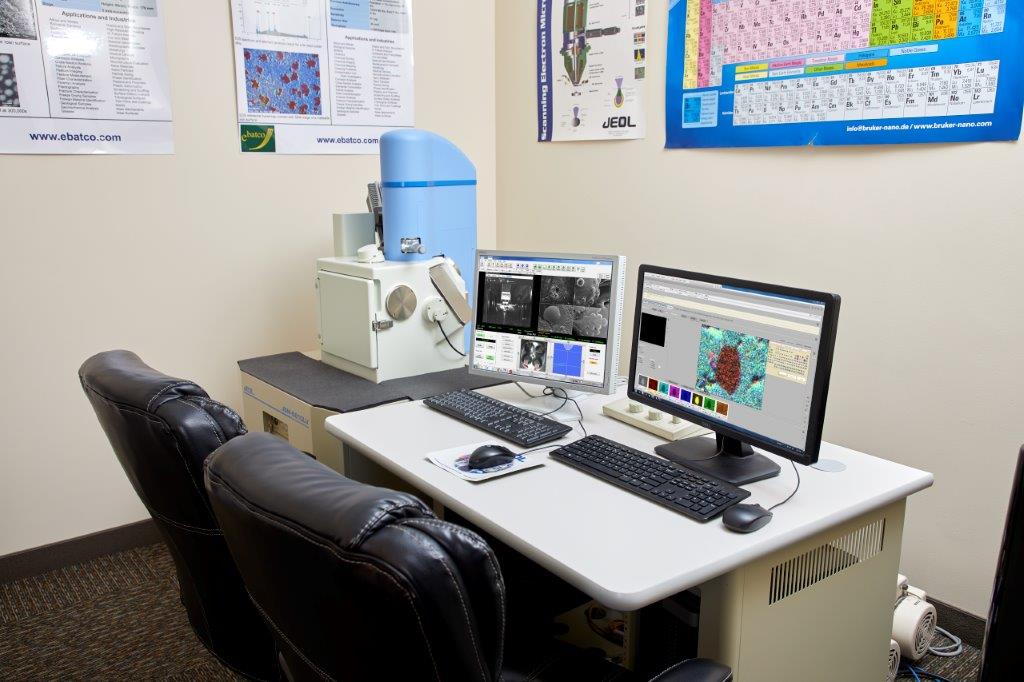
Instrument: JEOL 6610 LV Scanning Electron Microscope

JEOL 6610 LV Scanning Electron Microscope in laboratory

Instrument Key Specifications

FilamentW hairpin filament
ResolutionHigh Vacuum: 3nm (30kV),
8nm (3kV), 15nm (1kV)
Low Vacuum: 4 nm (30kV)
Accelerating Voltage300 V to 30 kV
Magnification5x to 300,000x
LV DetectorMulti-segment BSED
LV Pressure10 to 270 Pa
Sample SizesHeight: 80mm; Width: 178 mm
StageEucentric 5 axis motor control, asynchronous movement, x-y: 125mm-110mm, z: 5mm-8mm, tilt:-10 to 90 degrees, rotation: 360 degrees
Resolution5120 x 3840 pixels
Condenser LensZoom condenser lens
Objective LensConical objective lens


Identify Unknown Coating and Materials by Energy Dispersive Spectroscopy

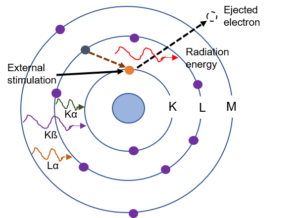
Have some unknown samples? We can help you to determine what they are and where they came from.  X-ray Energy Dispersive Spectroscopy (EDS) is a semi-quantitative x-ray technique that can identify and measure chemical composition in SEM analysis. Figure 1 shows the principle of EDS. The SEM focuses an electron beam on the sample surface.  The electrons knock core-shell electrons out of atoms inside the sample.  To fill this vacancy, a higher energy electron from the atom will fall down to take its place, and the difference in energy between the two states is emitted as an x-ray.  The generated x-rays possess energies unique to the element which are dependent upon the atomic number (Z) and the orbital transition involved. Measuring the spectrum of emitted x-ray allows for chemical characterization of the sample.

Representation schematic of EDS from electron orbital with characteristic wave lengths

Figure 1. A representation of the principle behind EDS.

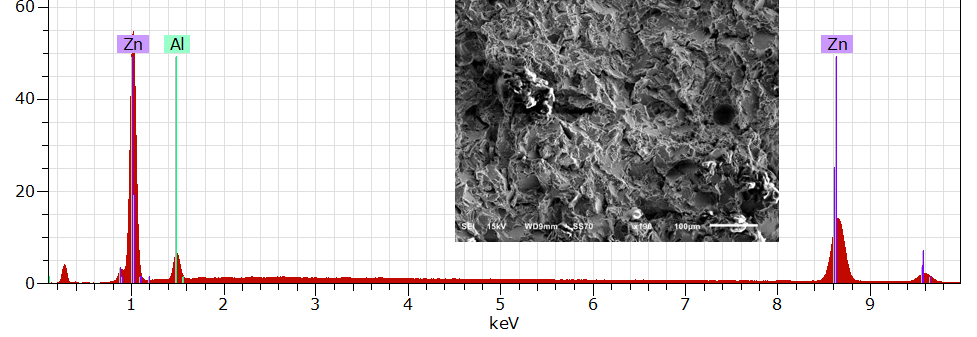
This project, an automotive emblem of unknown composition was analyzed by SEM/EDS. EDS can measure the composition at a single point, along a line, or map an area. In this case, the chemical composition was analyzed by EDS area scanning following ASTM E1508 – 12a using an accelerating voltage of 15 kV, take-off angle of 35º, and sample tilt of 0º. The test was performed using a standardless method with P/B-ZAF matrix correction. Figure 2 shows a typical microstructure and the resulting EDS spectrum. Five randomly selected areas at 200X magnification were analyzed by EDS.

EDS spectra on unknown zinc alumina sample

Figure 2. Typical microstructure and EDS spectrum result of unknown sample

Through EDS, we found that this sample is mainly composed of Zn with Al as an alloying element. The elemental concentrations were calculated by difference, and the K lines were selected to do the quantitative analysis. Table 1 lists the individual and average EDS results. The average concentrations of Zn and Al are 93.8 and 6.2 wt% respectively, which is a common composition for zinc die castings. Zn alloys have excellent finishing characteristics for plating, and chromate treatments. It is low cost, has excellent thin wall capabilities, and possesses high strength and hardness.

Table 1: Chemical compositions of an automotive emblem by EDS analysis

Element Area 1Area 2Area 3Area 4Area 5Average
Zn (wt%)92.094.894.294.094.193.8
Al (wt%)8.05.25.86.05.96.2

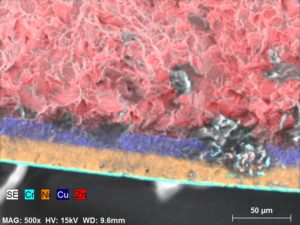
EDS can also do high resolution composite element mapping. Through the element map, we can see a detailed overview of where the different elements are located. Figure 3 clearly indicates that there were three layers of coating on the emblem. The innermost layer in direct contact with the Zn-Al substrate was identified as Cu. The middle layer was Ni, and the outermost layer was Cr. This coating was likely prepared by an electroplating process where the Cu layer facilitated the formation of a good Ni coating. This is a common processing step for electroplating Ni onto cast metal parts. The thicknesses of the Ni and Cr coatings are approximately 20 and 2 µm, respectively.

500X SEM elemental mapping of Zn, Cu. Ni, Cr

Figure 3. Element mapping images of unknown sample’s coating.


ASTM Standards

ASTM

Title

Website Link

A247Standard Test Method for Evaluating the Microstructure of Graphite in Iron CastingsLink
A262Standard Practices for Detecting Susceptibility to Intergranular Attack in Austenitic Stainless SteelsLink
A763Standard Practices for Detecting Susceptibility to Intergranular Attack in Ferritic Stainless SteelsLink
A802Standard Practice for Steel Castings, Surface Acceptance Standards, Visual ExaminationLink
A892Standard Guide for Defining and Rating the Microstructure of High Carbon Bearing SteelsLink
B276Standard Test Method for Apparent Porosity in Cemented CarbidesLink
B487Standard Test Method for Measurement of Metal and Oxide Coating Thickness by Microscopical Examination of Cross SectionLink
B578Standard Test Method for Microhardness of Electroplated CoatingsLink
B657Guide for Metallographic Identification of Microstructure in Cemented CarbidesLink
B748Standard Test Method for Measurement of Thickness of Metallic Coatings by Measurement of Cross Section with a Scanning Electron MicroscopeLink
B796Standard Test Method for Nonmetallic Inclusion Content of Powders Intended for Powder Forging (P/F) ApplicationsLink
E1508 Standard Guide for Quantitative Analysis by Energy-Dispersive SpectroscopyLink
E3Standard Guide for Preparation of Metallographic SpecimensLink
E340Standard Test Method for Macroetching Metals and AlloysLink
E381Standard Method of Macroetch Testing Steel Bars, Billets, Blooms, and ForgingsLink
E384Standard Test Method for Microindentation Hardness of MaterialsLink
E407Standard Practice for Microetching Metals and AlloysLink
E45Standard Test Methods for Determining the Inclusion Content of SteelLink
E562Standard Test Method for Determining Volume Fraction by Systematic Manual Point CountLink
E7Standard Terminology Relating to MetallographyLink
E768Standard Guide for Preparing and Evaluating Specimens for Automatic Inclusion Assessment of SteelLink
E930Standard Test Methods for Estimating the Largest Grain Observed in a Metallographic Section (ALA Grain Size)Link

ISO Standards

ISOTitleWebsite Link
209Wrought Aluminium and aluminium alloys — Chemical compositionLink
3887Steels — Determination of the depth of decarburizationLink
4499-1Hardmetals — Metallographic determination of microstructure — Part 1: Photomicrographs and descriptionLink
4499-4Hardmetals — Metallographic determination of microstructure — Part 4: Characterisation of porosity, carbon defects and eta-phase contentLink
5949Tool steels and bearing steels — Micrographic method for assessing the distribution of carbides using reference photomicrographsLink
643Steels — Micrographic determination of the apparent grain sizeLink
6872Dentistry — Ceramic materialsLink
9220Metallic coatings — Measurement of coating thickness — Scanning electron microscope methodLink