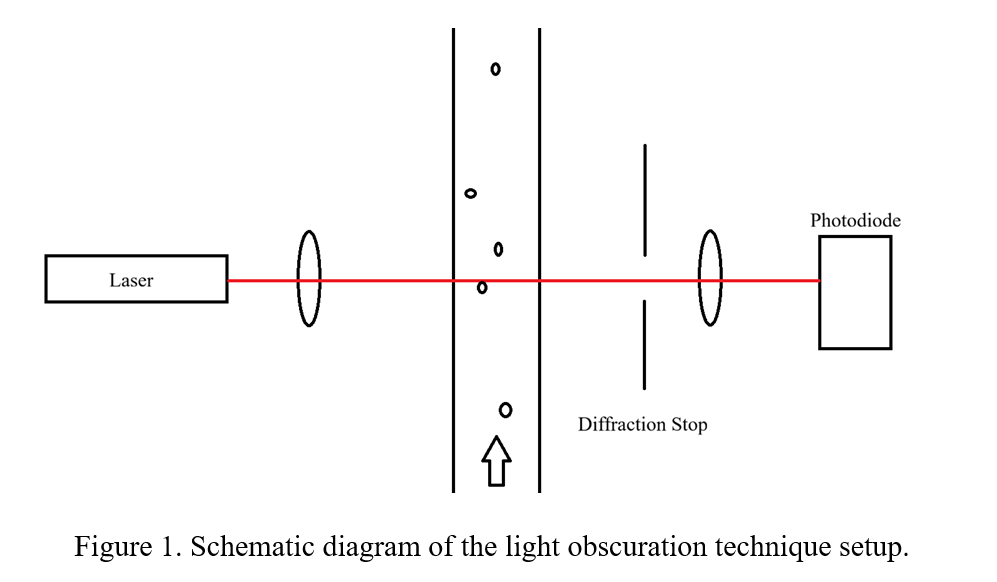
The light obscuration method is a high-resolution analysis technique for particle counting and sizing used in various pharmaceutical applications. In this method, a solution containing particles is drawn through a tube by a syringe. Light from a laser is shined through the tube onto a detector. When a particle passes through the laser light, it casts a shadow onto the detector. The corresponding drop in signal from the detector is then used to determine the equivalent circular diameter of the particle, and the number of drops is counted to determine the number of particles in the sample. A multi-point calibration ensures accurate counts across a wide range of particle sizes.
Ebatco’s NAT Lab is equipped with a Beckman Coulter HIAC 9703+ Light Obscuration Particle Counter, which is purpose-built for parenteral product testing and allows for quick, automated particle counting in compliance with USP 787, USP 788, and USP 789. The instrument can be configured to use different volume and flow rates, which allows for testing of small and large volume injections. SOPs can be programmed directly into the machine, allowing for easy availability of regulatory standard testing and automatic PASS/FAIL detection.
Typical Experimental Results

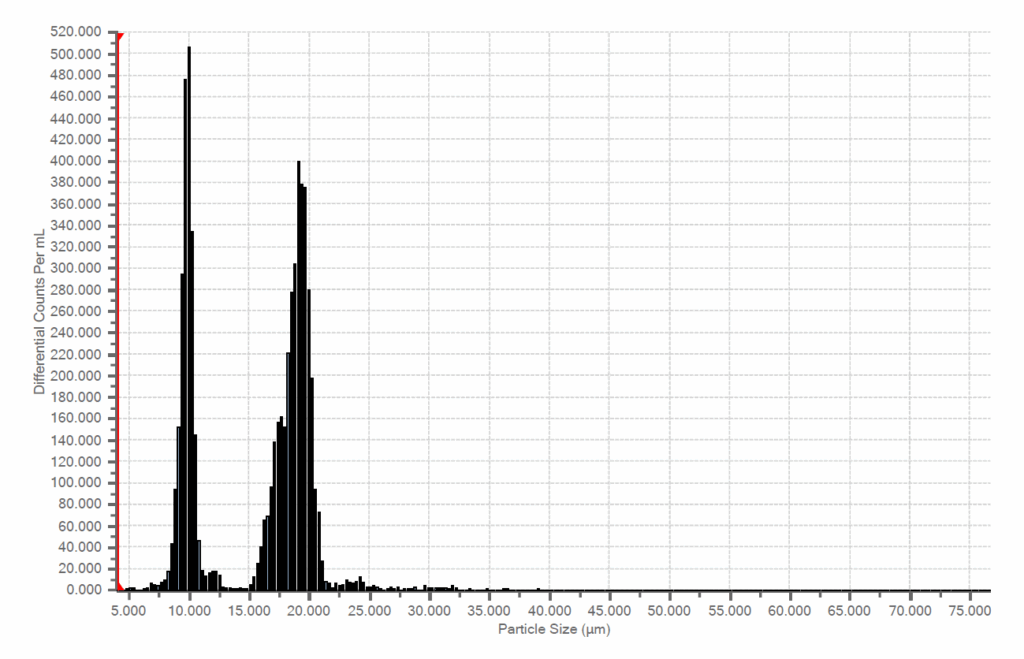
Particle distribution for a mixture of 10 and 20 µm latex spheres.
Syringe Wash Test in reference to USP 787 with Different Types of Syringes.
| Type of syringe | Particles greater than 10 µm (/mL) | Particles greater than 25 µm (/mL) | USP 787 PASS/FAIL |
| Disposable Polypropylene Syringe | 14.43 | 0.07 | PASS |
| Glass Syringe | 3.53 | 0.07 | PASS |
Applications
| Biomedical | Biotechnology | Cell Biology |
| Drug Development | Injectables | Microspheres |
| Ophthalmic Solutions | Parenteral Injections | Particle Size Distribution |
| Particle Sizing | Particle Counting | Pharmaceuticals |
| Proteins | USP 787 | USP 788 |
| USP 789 | Vaccines | Water Contamination |
Instrument: Beckman Coulter HIAC 9703+ Liquid Particle Counter

Instrument Key Specifications
| Particle Size Range | 1.3 to 150 μm diameter |
| Maximum Concentration | 18,000 particles/mL |
| Flow Rate | 10-50 mL/min |
| Flow Rate Accuracy | >95% |
| Volume Accuracy | >95% of syringe size |
| Smallest Tare Volume | 0.091 mL |
| Smallest Sample Volume | 0.2 mL |
For more information, please read our application notes:
Subvisible Particulate Counting Using Light Obscuration Technique Following USP 787, 788 and 789, PDF
All application notes can be found here
Subvisible Particulate Counting Using Light Obscuration Technique Following USP 787, 788 and 789
Injectables and ophthalmic solutions contain three types of particulate matter: extrinsic, intrinsic, and inherent particles. Extrinsic particles are unexpected foreign materials, such as cellulose. Intrinsic particles result from product processes, such as contamination from lubricants, manufacturing hardware, or product/packaging instability. Inherent particles are formulation components or protein particles. To ensure the health and safety of those who use the injectable or opthalmic solutions and to pass the proper regulatory guidelines, rigorous quality control testing is required. One of those testing techniques is particle counting via light obscuration.

The light obscuration technique, with a typical schematic diagram shown in Figure 1, is used for the United States Pharmacopeia (USP) Chapters 〈787〉 Subvisible Particulate Matter in Therapeutic Protein Injections, 〈788〉 Particulate Matter in Injections, and 〈789〉 Particulate Matter in Ophthalmic Solutions to determine the sizes and concentrations of particulates in injectables and ophthalmic solutions. The technique relies on a beam of light passing through a test chamber and onto a detector. When a particle suspension liquid sample is drawn through the test chamber, particles in the sample partially obscure the light beam and lower the intensity of light detected at the detector. From the magnitude, duration, number of the light intensity drops, and a known liquid pumping speed, the size, total number, and concentration of the particles are determined. The technique is sensitive and is optimal for samples with a low concentration of particulate matter.
Ebatco’s NAT Lab is equipped with a Beckman Coulter HIAC 9703+ Particle Counter, which uses the light obscuration technique. With the current configuration, the HIAC 9703+ can measure particles between 1.3 and 150 µm in diameter, and concentrations between 0 and 18,000 particles per milliliter. According to Beckman Coulter, the instrument is in full compliance with USP 787, 788, and 789. It can support USP 787 tests with an aliquot volume as small as 0.2 mL.
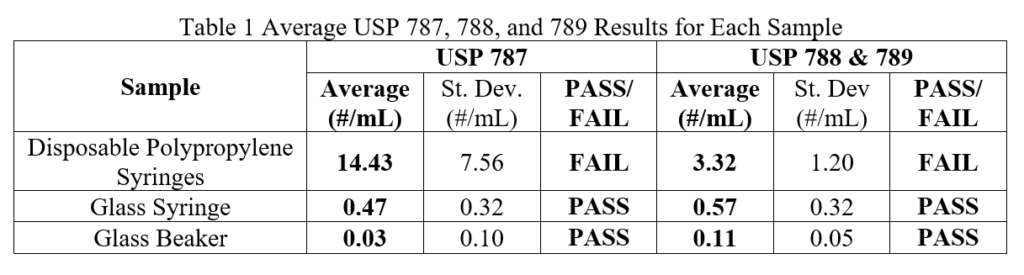
In this Application Note, Ebatco tested deionized water drawn through disposable polypropylene syringes, glass syringes, and glass beakers to determine compliance with the three USP chapters. Aliquots of 1 mL each were tested in accordance with USP 787, and aliquots of 5 mL each were tested in accordance with USP 788 and 789. USP 787 requires that the test environment, such as beakers or syringes, have less than 1 particle greater than 10 µm in diameter per milliliter when tested with deionized water. USP 788 and 789 require that there be less than 25 particles greater than 10 µm in diameter between five aliquots of 5 mL each, which is equivalent to less than an average of 1 particle per milliliter. The test results are reported in Table 1. The glass syringes and glass beakers both passed the USP 787, 788 and 789 environmental requirements. The disposable polypropylene syringes did not pass the USP 787, 788, or 789 environmental requirements. As such, the disposable polypropylene syringes tested here are not deemed suitable for use with therapeutic protein injections. Additionally, the disposable polypropylene syringes’ particle concentration was found to be notably higher when tested with a lower sample volume.

When performing subvisible particulate counting following USP 787, 788, and 789 using the light obscuration technique to test injectables and ophthalmic solutions, limiting the introduction of particles from the testing environment is extremely important. Based on this limited study, disposable syringes may introduce particles from packaging or lubricants, and as such may not be suitable for USP 787, 788, or 789 sample handling. Glassware, when thoroughly cleaned, has little impact on particle counts and is preferable.
USP Standards