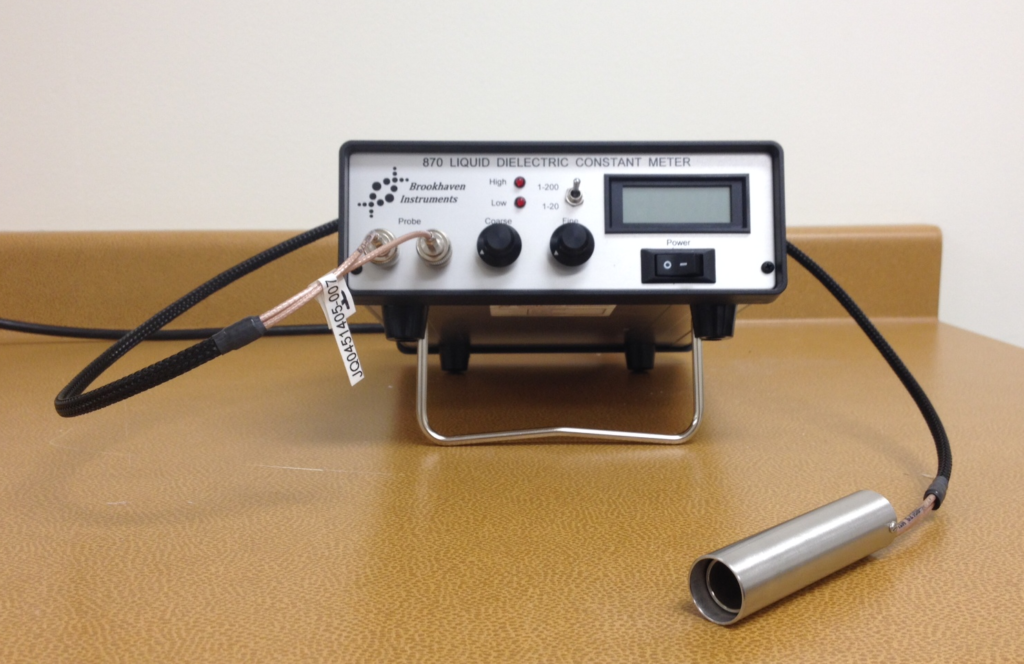
Ebatco’s NAT Lab is equipped with a Brookhaven BI-870 Dielectric Constant Meter. The BI-870 utilizes two concentric stainless-steel cylinders as a probe. The instrument applies a low-distortion, 10 kHz sine wave of electrical signal between the outer cylinder and inner cylinders while the resulting current is measured. Using the current and precise knowledge of the probe’s geometry and capacitance, the dielectric constant of a liquid is determined.

A material’s dielectric constant, ε, is a measure of a material’s ability to store electrical energy when placed in an electrical field. It is often normalized to ε0, the permittivity of vacuum.  This normalized value is called relative permittivity, εr, and is defined as:

Relative permittivity is the factor by which the electrical field between two point charges is reduced by the material relative to vacuum. Materials with large relative permittivity’s often make good capacitors.

While the dielectric constants for most pure liquids are well documented, those of mixtures and the effects of impurities are still being studied. The complex molecular interactions in the liquid state mean that there is no simple way to accurately calculate the dielectric constant of a liquid mixture, so the best way to determine the dielectric constant is to measure it directly. This is especially useful for Zeta potential measurements where the liquid used to keep particles in suspension may be comprised of several different liquids.


Typical Experimental Results

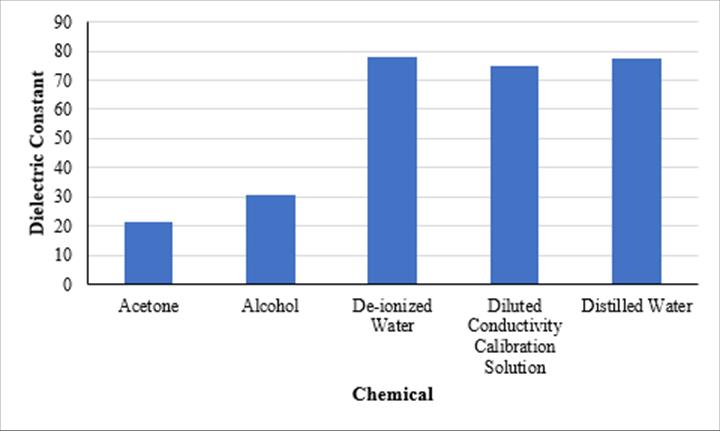
Dielectric Constant Acetone, Alcohol, De-ionized Water, Calibration Solution, Distilled Water

Dielectric Constants of Commonly Used Liquids


Applications

Biomaterials
Biomolecules
Chemicals
Chemical Etching
Chemical Formulation
Chromatography
Colloidal Suspension
Distilled Water
De-ionized Water
Electrolytes
Failure Analysis
Inorganic Liquids
Insulation Materials
Liquid Mixtures
Medical Formulations
Organic Liquids
Pure Liquids
Purity of Liquids
Relative Permittivity
Particle Size Analysis
Particle Zeta Potentials
Semiconductor Washing
Solid Zeta Potentials
Solutions
Suspensions
Temperature Dependent Solutions
Zeta Potential Measurements

Instrument: Brookhaven Instruments 780 Liquid Dielectric Constant Meter

Brookhaven 870 Dielectric Constant Meter Instrument

Instrument Key Specifications

Full Scale of SensitivityDielectric Constant of 1 – 20 and 1 – 200
Maximum Conductivity of SampleRange 1-20: 1 μS/cmRange 1-200: 10 μS/cm
Accuracy±2%
Repeatability and Linearity0.2%
Probe MaterialsStainless Steel and Teflon
Minimum Liquid Required23 mL for Standard Probe
Operating Temperature22-58 °C
Measurement SignalLow-distortion 10 kHz Sine Wave

For more information, please read our application notes:
Dielectric Constant Determination for Aqueous Solutions of Alcohol, PDF
All application notes can be found here


Dielectric Constant Determination for Aqueous Solutions of Alcohol

Dielectric constant is a measure of a material’s ability to store electrical energy when placed in an electrical field. It is also referred to as relative permittivity; it is typically denoted as εr; and it is defined as:

where ε is the permittivity of the material, and ε0 is the permittivity of vacuum. Relative permittivity is the factor by which the electrical field between two point charges is reduced by the material relative to vacuum. It can also be expressed as the ratio of the capacitance of a capacitor using the material as a dielectric, Cx, compared to the capacitance of a similar capacitor using vacuum as a dielectric, C0:

While the dielectric constants for most pure liquids are easy to find, they may vary depending on the impurities present in the liquids or if the liquids are mixed with other liquids. Since there is no universal way to calculate the dielectric constant of a mixture, the best way to determine the dielectric constant is to measure the dielectric constant of the liquid mixture directly. This is especially useful for Zeta potential measurements where the liquid used to keep particles in suspension may be comprised of several different liquids.

Dielectric Constant with varying alcohol concentrations

The Brookhaven BI-870 Dielectric Constant Meter, equipped in Ebatco’s Nano Analytical and Testing (NAT) Lab, is capable of measuring the dielectric constants of liquids. The BI-870 utilizes two concentric stainless-steel cylinders as a probe. The instrument generates a 10 kHz very low distortion sine wave of electrical signal at the outer cylinder and measures the conductive and capacitive currents between the two cylinders at the inner cylinder. By measuring the currents generated by this stable voltage source and knowing precisely the probe parameters, the dielectric constant of a liquid can be readily measured.

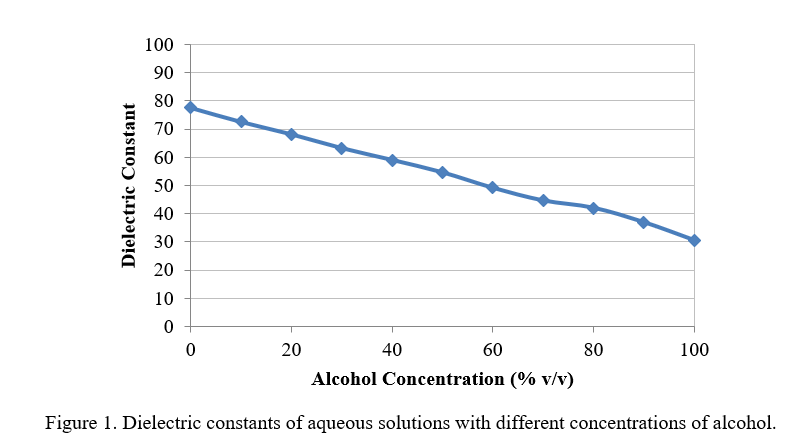
Figure 1 and Table 1 show the measured dielectric constants of aqueous solutions with various concentrations of denatured alcohol at room temperature. The results show a relatively linear relationship for the dielectric constants of water and denatured alcohol solutions with their alcohol concentrations.

In this instance, the dielectric constants for the solutions containing other alcohol concentrations can be approximated using the linear relationship. However, for many other mixtures, especially for more complex mixtures, this may not be the case. As the instrument manufacturer has stated “Although it is very tempting to try to apply simple mixing rules to approximate a new dielectric constant, there is no simple equation that will adequately characterize the interaction of fluids to calculate dielectric constants of mixed liquids. Thus direct measurement is the only recourse.” When the dielectric constants of liquids are needed for their intended uses, measurements should and can be made in order to obtain precise and accurate values.


ASTM Standards

ASTMTitleWebsite Link
D924Standard Test Method for
Dissipation Factor (or Power Factor) and Relative
Permittivity (Dielectric Constant) of Electrical Insulating
Liquids
Link